Get Full Government Meeting Transcripts, Videos, & Alerts Forever!
Get email alerts on the Labor Enforcement topic
No spam. Unsubscribe anytime.
Department of Labor’s Wage and Hour Division details how it enforces wage laws and helps workers
Summary
A presenter from the U.S. Department of Labor’s Wage and Hour Division outlined the agency’s mission, how investigations proceed, common wage-and-hour violations, and how workers and employers can file complaints or access compliance resources.
A presenter from the U.S. Department of Labor’s Wage and Hour Division outlined on video how the agency enforces federal wage laws, investigates complaints and directed matters, and supports employers and workers with resources and trainings.
The presentation, described as practical and informational, explained that the division enforces standards on minimum wage, overtime, child-labor protections, family and medical leave issues and other worker protections. The presenter said the division’s work affects nearly 155,000,000 workers in more than 12,000,000 U.S. workplaces and that WHD maintains 152 offices nationwide to carry out investigations and outreach.
The presenter emphasized that the session was for general information and not legal advice, directing viewers to the Federal Register and the Code of Federal Regulations for official regulatory language. He explained how state and federal rules interact: when both apply, the law that offers the greater protection to workers governs, and employers who comply with the strictest applicable law are compliant with the more lenient one.
On enforcement, the presenter said WHD is a neutral fact-finder that accepts confidential complaints from current and former employees, third parties and competitors, and that management screens complaints before assigning an investigator. Investigations typically include an initial conference with the employer, a site tour, private interviews of employees to verify payroll and duties, a review of employer records (payroll, birthdates, time records) and a final conference to discuss findings and corrective steps. When back wages are owed, the presenter said the Fair Labor Standards Act gives the department authority to recover back wages, liquidated damages and, in some cases, assess civil money penalties.
The presenter also described directed investigations that WHD initiates without a specific complaint, noting these are chosen through strategic planning based on industry trends, geography and patterns of violations. He said the division recovered hundreds of millions of dollars in back wages annually and that it operates interpretation services in more than 200 languages to improve access.
Common violations the presenter listed included illegal payroll deductions (for shortages, uniforms or materials), improper pay practices for tipped workers, failure to count pre- or post-shift work and unpaid travel time between worksites, misapplied overtime exemptions for salaried employees, and mistakes in calculating the regular rate for overtime when bonuses or shift differentials apply. The presenter urged employers to use WHD compliance resources and trainings to avoid these errors.
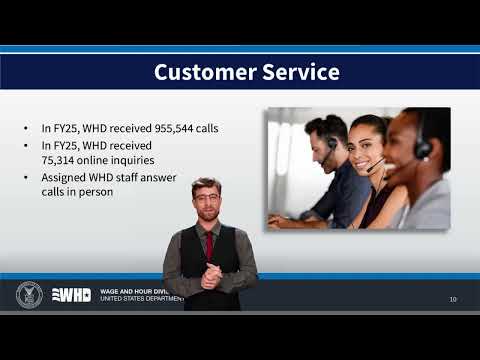
On public access, the presenter said the division answers calls in person on a toll-free helpline and received almost 1,000,000 calls last year; callers also may submit inquiries online and request callbacks when call volumes are high. All complaints are confidential, and investigators generally do not disclose the reason for an investigation unless expressly permitted.
The presenter closed by urging viewers to visit dol.gov/whd, use the toll-free helpline, and follow Department of Labor channels for news and guidance.