Get Full Government Meeting Transcripts, Videos, & Alerts Forever!
Get email alerts on the Public Safety And Regulation topic
No spam. Unsubscribe anytime.
Council adopts rules to permit nonretail marijuana production sites with conditions after lengthy hearing
Summary
After nearly four hours of public testimony, the council voted 6–3 to adopt staff'recommended Option 2 (allowing nonretail production, manufacturing and testing with conditional use permits) with amendments directing further work on odor, grandfathering and caps; police and many parents urged the more cautious Option 1.
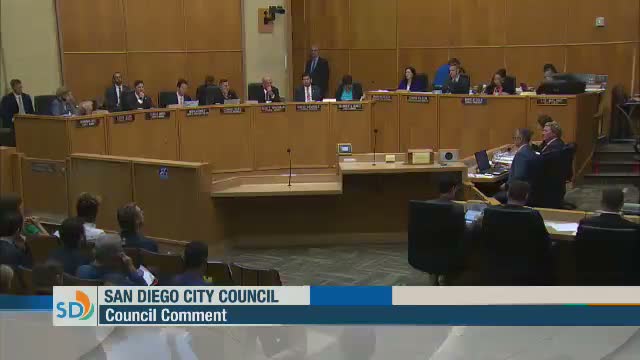
After more than an hour of staff explanation and several hours of public testimony, the San Diego City Council voted on Sept. 11 to adopt amendments implementing California's adult‑use marijuana law that allow non‑retail production uses under local controls.
Staff presented two options. Option 1, supported by the San Diego Police Department, would allow testing labs as a new permitted use while keeping cultivation, manufacturing and distribution prohibited. Option 2 would create a new use category—"marijuana production facilities"—to allow cultivation, manufacturing and distribution under conditional use permits (CUPs), limit locations to specified industrial and commercial zones, impose health and security rules, and cap the number of production facilities (the staff draft proposed two per council district).
Chief Shelley Zimmerman of the San Diego Police Department urged Option 1 on public safety grounds, saying the department had responded to hundreds of calls at the city'permitted dispensaries and warning that expanded production sites could increase burglaries, robberies and other calls for service. "I strongly endorse option number 1," she told the council, citing department experience and visits to other legalized jurisdictions.
Industry groups, business owners, scientists and patient advocates urged the council to approve Option 2 or a modified Option 2. They argued a local production and testing supply chain would help displace the black market, provide more rapid testing for product safety, create local jobs, and allow regulated delivery services. Several speakers asked the council for a higher citywide cap (40–50 facilities), for grandfathering or a multi‑year amortization period for Business Tax Certificate (BTC) or building‑permit holders, and for a permit pathway that would let existing compliant operators continue operating while CUPs are processed.
Council members debated the options and amendments. Council Member Ward moved to adopt Option 2 (subitems c, d and e) with amendments: a citywide cap (the maker proposed 40), removal of a proposed 100‑foot separation requirement between production facilities and other outlets, and direction that the city attorney and mayor's office return with draft odor‑control language and other public safety measures. Staff and the city attorney clarified the ordinance as written would allow existing business tax certificate and zoning use certificate holders 12 months to secure CUPs (staff noted that some existing operators may be outside proposed zones); some council members argued for extending that period to 24 months to protect parties that had invested in building permits.
Following debate, the council approved the motion 6–3; Council Members Zapp, Kate and Sherman voted no. Council directed the city attorney and mayor's office to prioritize analysis of odor controls and referred additional quality‑of‑life, labor and delivery issues to the public safety committee for further work before second reading. Staff emphasized the legal constraints and the need to ensure any new local standards align with state law and Brown Act noticing requirements.
The ordinance adopted a local framework to regulate production and testing facilities while leaving detailed standards (including odor controls, final cap and grandfathering mechanics) to additional staff work and committee review ahead of second reading.
Vote: motion passed 6–3 (Council Members Zapp, Kate and Sherman opposed).