Get Full Government Meeting Transcripts, Videos, & Alerts Forever!
Get email alerts on the Rezoning Meritbidco topic
No spam. Unsubscribe anytime.
Brevard County commissioners deny rezoning for 222‑unit Merritt Island apartment project after hours of resident testimony
Summary
After hours of testimony from developers and more than 40 residents, the Brevard County Board of County Commissioners voted unanimously to deny a rezoning request by Range Water (MeritBidco) for a proposed 222‑unit apartment complex on North Courtney Parkway and Pioneer Road in Merritt Island.
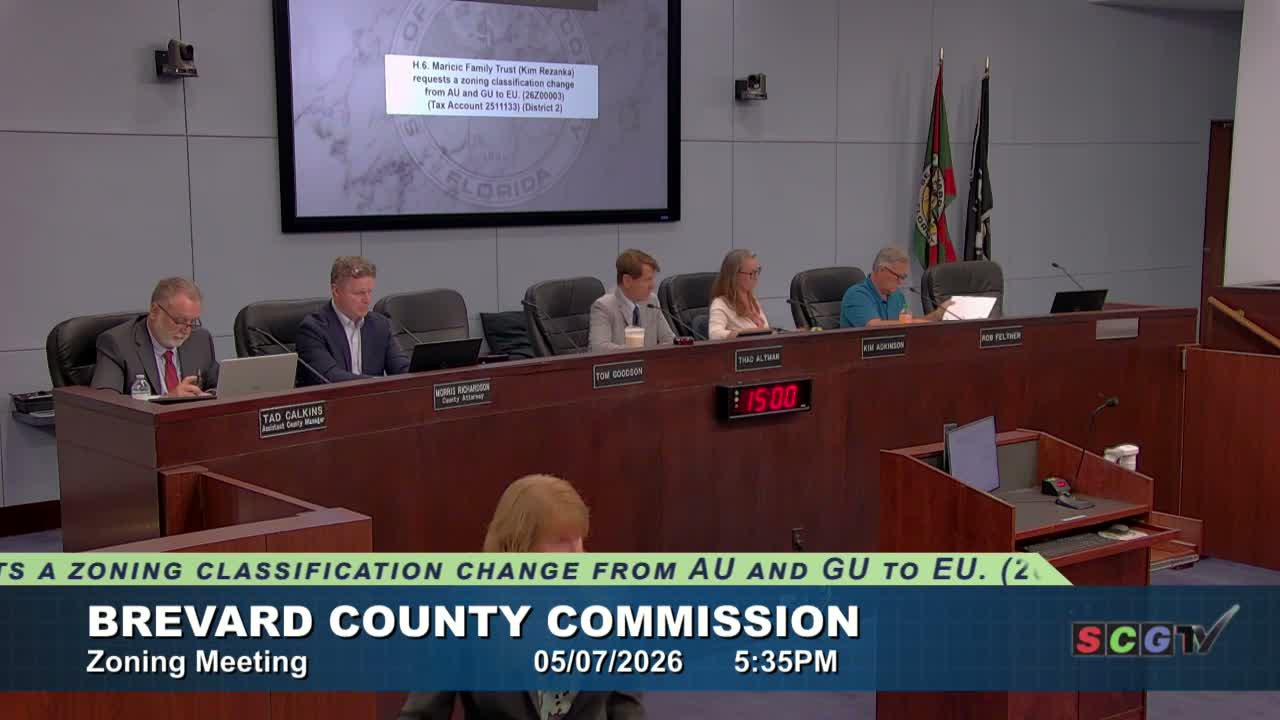
The Brevard County Board of County Commissioners voted unanimously May 7 to deny a rezoning request from MeritBidco SPV LLC/Range Water that would have allowed a 222‑unit, market‑rate apartment complex on Merritt Island.
The developer’s team, led by counsel Kim Rozenka and developer Michael Oliver, asked the board to rezone about 11.16 acres to RU‑215 and RU‑230 to permit up to 222 multi‑family units. Rozenka and Oliver emphasized that the project is consistent with the county’s 1988 comprehensive plan, proposed a binding development plan (BDP) including a 100‑foot setback on the east property line and other buffering, and said the company had voluntarily commissioned traffic studies and would provide off‑site improvements. "Range Water is prepared to invest more than $55,000,000 into the community," Oliver said during his presentation.
Opponents, including neighborhood associations and more than three dozen residents who spoke during a long public‑comment period, argued the location is inappropriate and that critical infrastructure and safety issues remained unresolved. Speakers cited traffic conflicts at the intersection of North Courtney Parkway and Pioneer Road — a corridor used for school drop‑off at Lewis Carroll Elementary — repeated neighborhood flooding and stormwater maintenance shortfalls, potential adverse impacts on wetlands and wildlife including an active bald eagle nest, and uncertainty over school capacity.
Resident testimony cited figures from the developer’s materials and independent analyses: opponents said the developer’s roadway analysis would add hundreds of daily trips to a segment of Courtney Parkway that county counts show is already close to capacity. A local engineer quantified water and sewer demand, noting that 222 units would consume roughly 55,500 gallons per day of potable water and about 44,400 gallons per day of sanitary sewer under county level‑of‑service figures.
Developers and their experts pushed back. Traffic engineer Trent Ebersole of Bowman told the board that the traffic impact study (the most recent dated 03/05/2026) concluded the project would not reduce roadway levels of service in the study area and that proposed improvements — including lengthening right‑turn lanes on Pioneer and Courtney — would mitigate peak‑period congestion. Site engineer Kyle Shasteen said wetlands delineations had been accepted by the St. Johns River Water Management District and that tree preservation and buffers were included in the BDP. The applicant also said the BDP would commit to design changes and that any remaining site‑engineering issues would be addressed at site plan and permitting stages.
Several residents and a land‑use attorney for the community argued the board must consider the county’s five rezoning factors at this hearing — including compatibility with existing uses, impacts on public facilities and infrastructure, and environmental constraints — and said the applicant had not met the burden of providing substantial, competent evidence that the rezoning met those criteria. "The burden of proof rests with the applicant," said Veronica Oechler, an environmental and land‑use attorney representing the Sykes Cove Community Association.
Following discussion among commissioners, Commissioner Goodson moved to deny the rezoning as incompatible with the surrounding area and instructed county staff to prepare findings of fact for a future meeting; Commissioner Atkinson seconded the motion. The board voted in favor; Rozenka raised procedural points during rebuttal about what evidence is required at rezoning stage, but the board completed the vote and directed staff to return the findings of fact at a later public meeting.
What happens next: staff will prepare written findings of fact explaining the legal basis for the denial and present them at a future Board of County Commissioners meeting. The denial does not preclude the applicant from refining a proposal and returning with additional information or proposing a different zoning approach, but the decision means the current application will not move forward as requested.
The board also handled several less‑controversial rezoning items earlier in the meeting: Millstone Ventures’ request to rezone about 18 acres to allow multifamily RU‑215 (approved), JEJ Ventures’ commercial rezoning from IU to BU‑2 for a proposed hardware store (approved), and other items including a request for RV/cabin and equestrian uses that were approved with conditions and requirements to finalize binding development plans with staff.
The county meeting transcript shows residents repeatedly urging commissioners to weigh immediate safety and infrastructure concerns — traffic at school drop‑off times, recurrent neighborhood flooding, and protection of wetlands and wildlife — in addition to long‑term land‑use goals. The commission’s denial reflects those concerns and requires the applicant to either address them or pursue alternative options.
Votes and next procedural steps: the motion to deny was moved by Commissioner Goodson and seconded by Commissioner Atkinson; the motion passed unanimously. Staff will draft findings of fact and return the matter to the board at a future public meeting for formalization.