Get Full Government Meeting Transcripts, Videos, & Alerts Forever!
Get email alerts on the Taxes topic
No spam. Unsubscribe anytime.
Senate Taxes Committee advances omnibus tax bill with property‑tax refunds, hospital tax and social‑media levy
Summary
The Minnesota Senate Taxes Committee voted to send an omnibus tax bill to the Senate floor after presenting measures that would raise a 12% one‑time property tax refund, create a Hennepin County health‑care tax, impose a tax on the largest social media platforms, fund communities affected by a recent "metro surge" enforcement action, and offer credits for sustainable aviation fuel and beginning farmers.
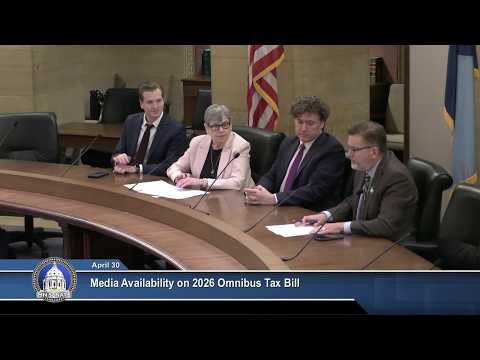
Sen. Rest, chair of the Senate Taxes Committee, presented an omnibus tax bill to the committee that he said combines bipartisan provisions to provide immediate relief to Minnesotans and to modernize the state tax code.
"It makes life more affordable," Sen. Rest said, summarizing the bill’s aims. He described a 12% increase in this year’s property tax refund and said the package includes a new Hennepin County health‑care tax and a social‑media tax targeted at the largest global platforms.
The bill would increase this year’s property tax refund by 12 percent, a change the committee said represents more than $100 million in direct relief for homeowners. Sen. Grant Hochschild, vice chair of the committee, told colleagues the proposal would provide about $100,800,000 in direct property tax refunds and estimated roughly $171 per resident if the measure becomes law. "Almost 80% of Minnesotans would benefit from this tax relief," Hochschild said.
Committee members emphasized a set of health‑care and local government measures aimed at Hennepin County. Sen. Rest said the bill would impose a quarter‑cent (0.25) Hennepin County health‑care tax intended to stabilize hospitals, including HCMC (a pediatric level‑1 trauma center) and North Memorial (an adult level‑1 trauma center). He said funds directed to North Memorial under the proposal must be used to cover uncompensated care, while Hennepin County would have flexibility to use its share for facility upkeep and planning.
The bill also includes a $2,000,000 provision to assist communities that faced costs tied to a recent enforcement action described in testimony as the "metro surge," helping local governments cover public‑safety and emergency response expenses that local property taxpayers otherwise would have borne.
On clean energy and rural development, Sen. Dibble described a sustainable aviation fuel (SAF) incentive providing up to $1.50 per gallon to spur in‑state production using Minnesota‑grown feedstocks and so‑called "forever green" winter‑hardy crops. He said the measure would drive private investment, create jobs and reduce lifecycle greenhouse‑gas emissions. The bill would also lift the cap on the beginning‑farmer tax credit extension, a step members said would ease farm transitions and encourage new entrants into agriculture.
The package contains a social‑media platform tax that Sen. Rest said applies to the 14 largest platforms doing business in Minnesota; he asserted that "not 1 single Minnesotan will pay a penny of it, not 1¢," characterizing the levy as targeting the platforms and their owners rather than ordinary users.
Committee members repeatedly framed the measure as a response to federal policy and economic pressures. Members criticized recent federal budget changes and said state relief is a necessary countermeasure for families, farmers and local governments.
Procedurally, the committee voted to send the omnibus tax bill to the Senate floor. Sen. Rest said the measure now awaits scheduling by Senate leadership and that a companion action in the Minnesota House is required for final passage. He noted the refund deadline in August as an implementation timeline to watch if the bill becomes law.
The committee did not record a detailed roll‑call vote in the transcript excerpt provided; committee leaders said they expect the House to review the Senate text and may add or change provisions before final action.