Get Full Government Meeting Transcripts, Videos, & Alerts Forever!
Get email alerts on the Roads And Infrastructure topic
No spam. Unsubscribe anytime.
Lucas council hears $2M near-term road plan and a $64.7M long-term concrete conversion proposal
Summary
At a special-call workshop, Lucas staff reviewed a pavement-condition survey and outlined near-term repaving and maintenance funded from a $1.35M baseline plus impact fees and a county reimbursement (bringing this yearto roughly $2.0M), and presented a decades-long $64.7M plan to convert many streets to concrete; staff will post the presentation and return with contractor quotes and budget options.
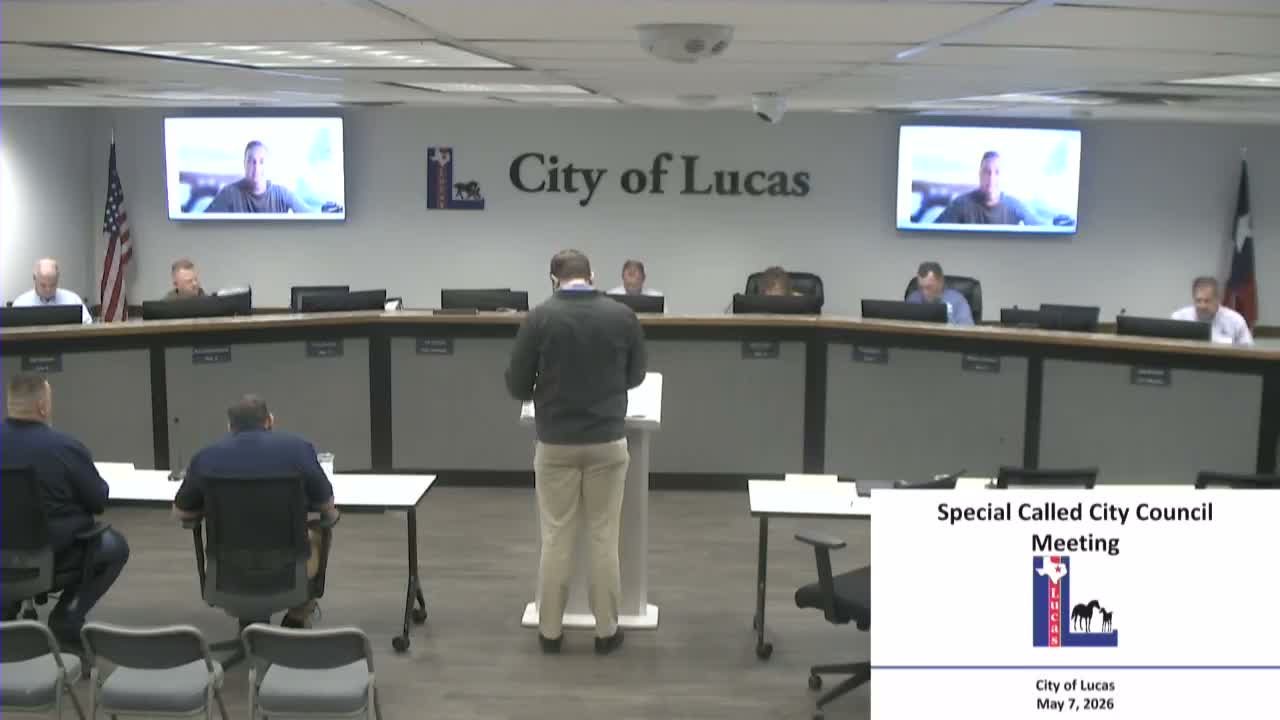
At a special-call meeting, the Lucas City Council heard a presentation from CIP manager Patrick Hubbard on the cityroads improvement program, including a pavement-condition survey, this yearfunding picture and a long-term conversion concept.
CIP manager Patrick Hubbard said the citycondition survey produced a score of "77," with "21.4 miles that are rated ... poor condition" and about "10.2" miles in another mid-range category. He told council the program has reallocated funds and that this year's projection is now roughly $2,000,000 because the original $1,350,000 allocation was supplemented by approximately $498,894 in impact-fee funds and about $182,000 in reimbursement from Collin County for Aztec Road; Hubbard said staff had already encumbered about $1,170,000 of that total.
"Looking at the condition survey from 2026, our overall score was 77," Hubbard said, and he described how NEXCOsegment-level sampling (every 33 feet) feeds a prioritization that targets concentrated failed sections rather than repaving entire stretches unnecessarily.
Mayor (speaker 1) emphasized the councilpriority on roads and the larger budget: "We've got the largest budget ever allocated towards this, and so it remains a priority," he said.
Near-term work and pilots
Hubbard said the near-term program remains heavily weighted toward repaving, with a planned shift toward more crack sealing later in the rollout. He reported a chip-seal pilot on Daytona Avenue and showed before-and-after photos of recent repairs in the Meadows and Woodmore subdivisions. Councilors asked if the chip/fog seal produced loose gravel; public-works staff said the two-course chip seal followed by a fog seal removed loose rock and that early driver feedback has been positive.
The city has piloted targeted patching (McMillan Road) and testing of crack-seal materials on concrete streets, Hubbard said, and staff plans to expand spot repairs where feasible to avoid high-cost reconstructions when only small sections have failed.
Budget and priorities
Hubbard said about $854,000 of pavement funds remained (normalized to the midyear budget) and roughly $160,000 remained for culvert and drainage projects; the majority of the pavement funds are earmarked for repaving. He listed immediate candidates for repaving as States Road, Holly Lane and portions of Cedar Bend Circle and Cedar Bend Trail, with Hickory Hill and portions of Lost Valley Drive to follow as funds permit.
Long-term conversion proposal
Hubbard presented a long-term "asphalt-to-concrete conversion" concept for many Type C streets and selected higher-traffic corridors, arguing concreteoffers longer service life and lower maintenance costs for heavily trafficked corridors. "But our estimate for what it's going to cost to do these conversions overall is about $64,700,000," he said, adding that the work could be financed as a series of bond packages or phased over decades; he gave two amortization frames roughly equivalent to $2.5 million per year on a 25-year aggressive schedule or about $1.2 million per year averaged over 50 years.
Hubbard said phasing considers segment length, traffic volume and coordination with other capital projects; he specifically cited West Lucas Road (a major CIP outlay), Snyder Lane (highly deteriorated) and Estelle in front of the school as early exceptions or priorities.
Next steps and transparency
Councilors asked whether the previously discussed $1.35 million budgeted baseline still stands as a five-year target to eliminate failing roads; Hubbard confirmed the 1.35M figure remained the technical baseline used in the prior workshop to reduce backlog (subject to inflation and future adjustments). Several councilors requested that the presentation and, later, the NEXCO segment-level sheets be posted online for public review. Hubbard agreed to post the presentation promptly and said he could make more detailed data available on request, while cautioning staff would help explain the data to avoid public misinterpretation.
There were no formal votes or motions at the workshop. Staff said they will return with contractor quotes and options (courses of action) for council consideration during the next budget cycle. The mayor recessed the meeting and said the council would reconvene at 6:30 p.m.
Ending
The workshop closed with staff committed to posting presentation materials online and to return with budget/options recommendations and contractor pricing for prioritized repaving and the pilot programs in the coming budget cycle.