Get Full Government Meeting Transcripts, Videos, & Alerts Forever!
Get email alerts on the Coordinated Entry topic
No spam. Unsubscribe anytime.
New ‘NASH’ assessment launched in pilot to reduce retraumatization and score manipulation
Summary
Dr. Monty Talley presented NASH, a shorter community-built housing needs-assessment designed to minimize retraumatizing questions, reduce score manipulation and add qualitative and visual inputs; pilots are blind and emphasize assessor training and accountability.
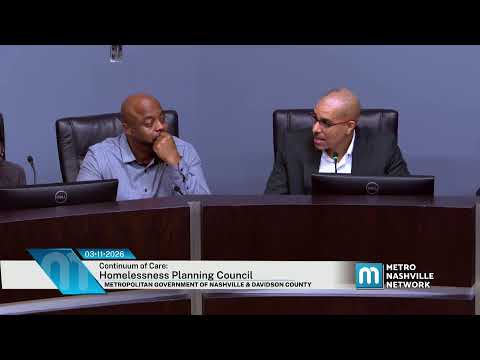
Dr. Monty Talley presented a new coordinated entry needs-assessment called NASH to the Homelessness Planning Council, describing it as a community-built, person-centered tool designed specifically for housing placement.
“Some people don’t know what NASH is,” Monty Talley said, explaining the tool has been under development for more than a year. He said the assessment is deliberately shorter than the existing VI-SPDAT-style tools, includes a qualitative assessor box and a visual assessment to capture nonquantifiable information, and is being piloted blind so assessors do not see scores during testing.
Talley said the older tool can be retraumatizing and that assessors sometimes (with the best intentions) inflate answers to move clients toward housing. “This tool has much fewer questions,” he said, and the pilot’s blind design and training focus are intended to reduce score manipulation.
During questions, members pressed how the tool will prioritize people newly experiencing homelessness. Talley said a pre-assessment triage and branching logic are part of the design so people with lower needs can be connected quickly to prevention and diversion resources rather than waiting until needs escalate.
On accountability, Talley said the core assessment group is discussing consequences if assessors intentionally manipulate scores, calling for built-in accountability mechanisms. He emphasized that training is central: “We could create the most perfect tool but without the support, without the training and accountability that goes with it, we will be right back where we are.”
Talley said the NASH tool is focused on housing (not a health assessment) and that implementation will require careful change management because assessors and providers are accustomed to the existing scoring system.
The presentation closed with members asking about previewing the tool and participating in training; Talley invited council members to join core assessment-group meetings and training sessions. The council did not take action because the meeting lacked quorum; staff said they will continue piloting and report back to the HPC as testing progresses.