Get Full Government Meeting Transcripts, Videos, & Alerts Forever!
Get email alerts on the Water Restrictions topic
No spam. Unsubscribe anytime.
Monte Vista council adopts seasonal watering limits, bans Sunday watering and daytime irrigation
Summary
After a San Luis Valley drought briefing, the Monte Vista City Council voted to renew and modify a watering resolution, banning watering between 10 a.m. and 6 p.m. and prohibiting watering on Sundays; council will revisit stricter stage‑2 limits at its June 4 meeting.
Monte Vista — The City of Monte Vista adopted a modified watering resolution on April 16 that limits outdoor irrigation hours and prohibits Sunday watering as the San Luis Valley faces an unusually dry year. The vote renews the city’s longstanding water‑efficiency schedule with council amendments and schedules a June 4 review to consider tighter restrictions if conditions worsen.
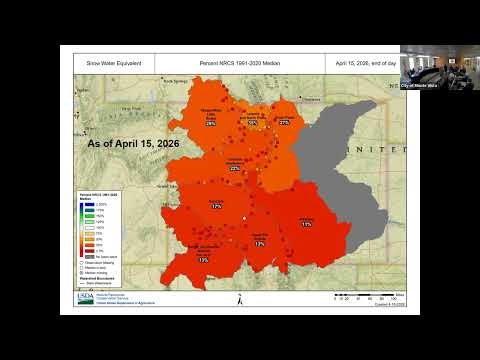
The council approved Resolution 2026‑11 with the changes after a presentation from Pat McDermott of municipal water resources, who described this year’s basin conditions as “one of the worst years” in recent records and compared 2026 to drought benchmarks such as 1977 and 2002. “Without a couple more abundant years, we’ll fully set a new record,” McDermott said, emphasizing immediate impacts to streamflow, aquifer storage and fisheries.
Rob (city staff) read two written public comments urging stricter limits. One resident’s emailed request, read into the record, called for reducing watering to three days per week and prohibiting midday irrigation to reduce evaporation. Another forwarded letter urged an odd/even schedule limited to three days weekly, daytime restrictions between 9 a.m. and 6 p.m. and a clear, tiered enforcement plan tied to the U.S. Drought Monitor.
Council discussion focused on balancing conservation goals with the cost and logistics of enforcement and protecting newly planted trees and grant obligations. Staff noted the city has no dedicated code‑enforcement officer and that police resources are constrained; the city manager would be authorized to enforce the ordinance under municipal code. Councilors agreed on an initial modified schedule (odd/even three‑day pattern with no watering 10 a.m.–6 p.m. and no Sunday watering), with a plan to revisit and potentially move to stage‑2 (two days/week and a stricter fine schedule) at the June 4 meeting.
The Stage‑2 fines outlined in staff materials were described as: first offense — written warning; second — $100; third — $250 plus court summons; fourth or more — court summons and fines up to $1,000 (final penalties set by the judge). Council indicated it would favor educational warnings at first but left fines in the stage‑2 draft if escalation is needed.
Pat McDermott and other staff urged irrigation management changes that reduce waste — for example, avoiding watering during windy or hot hours and shifting watering times to cooler periods — as the most effective ways to extend supplies. Residents and councilors also discussed humic acid and other soil amendments that can improve moisture retention.
The resolution passed on a roll call vote; council asked staff to publish the modified schedule and an education piece on the city website and water bills, and to return with an update at the first June meeting.
The council’s action applies from April 16 through Oct. 16, 2026, consistent with the city’s irrigation season and the timeline in the staff materials.