Get Full Government Meeting Transcripts, Videos, & Alerts Forever!
Get email alerts on the Land Use Data Centers topic
No spam. Unsubscribe anytime.
Residents urge county moratorium on data centers, citing health, water and traffic risks
Summary
Public commenters at the Butler County Board of Commissioners meeting called for a temporary moratorium on data-center construction countywide until independent health, environmental, noise and traffic studies are completed; speakers cited Trenton as a cautionary example and raised disputed water-use figures.
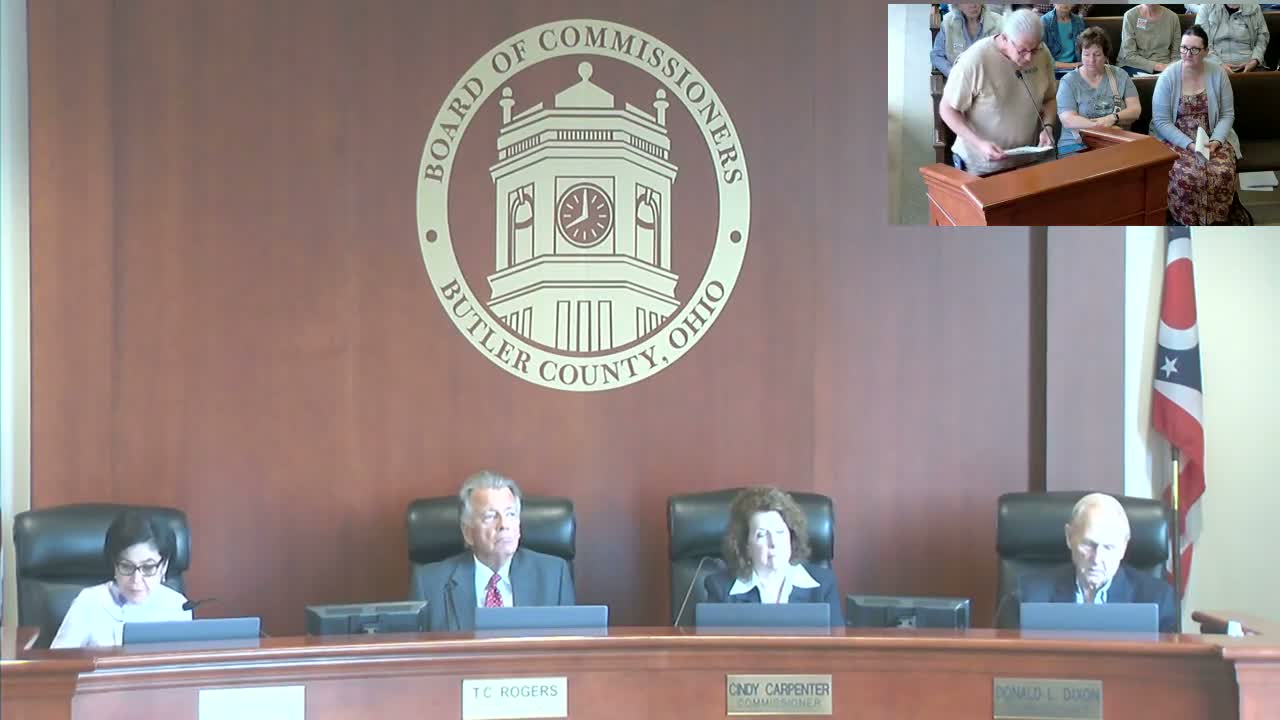
Public speakers at the Butler County Board of Commissioners’ March 31 meeting urged the board to impose a temporary moratorium on all data-center projects in Butler County until independent studies assess health, environmental and traffic impacts.
Barry Blankenship, who said he represents WATER (Woodsdale and Trenton Environmental Resistance), asked commissioners to “make motion and a vote on a moratorium on all data centers in our county, both planned and unplanned, until comprehensive independent studies are completed.” He told the board the pause should last until health-impact assessments, environmental-impact studies, noise studies and regional traffic analyses are complete.
Melinda Zemper, a board member of Save Ohio Parks, said a Trenton-area data center powered by natural gas could have broad climate and health effects, adding: “We can live without AI data centers. We cannot live without clean air, clean water, and good health.” She said she would provide sources for her emissions and health statistics by email.
Lori Blankenship, a Trenton resident, described process concerns in her city and contested the developer’s water-use figures. She said developer Prologis initially told the city the project would use 2,000,000 gallons of water per day, later revised that to “15,000,000 gallons of water a year” and then to “41,000 gallons a day” in the transcript; she asked commissioners to consider a 12‑month county moratorium until a state study commission completes its review.
Speakers framed the request as a county-level responsibility when projects cross municipal boundaries: several commenters said adjacent jurisdictions, parks and county systems had not been adequately consulted and that county oversight is necessary when infrastructure affects multiple communities. No commissioner discussion or action on a moratorium occurred during the meeting.
The board’s meeting packet and staff reports presented routine approvals and budget items earlier in the session; the public-comments period was limited to three minutes per speaker, and commissioners said they would not engage during remarks. The agenda proceeded to other business after the public-comment period closed.