Get Full Government Meeting Transcripts, Videos, & Alerts Forever!
Get email alerts on the Public Safety topic
No spam. Unsubscribe anytime.
Chaffee Fire chief briefs trustees on new food‑truck code requirements, fleet purchases and JP CHIPS mitigation
Summary
Kira, fire chief for Chaffee Fire, told trustees the state resiliency code imposes new suppression and hood requirements on food trucks that are costly to retrofit; she reviewed water‑wise training adjustments, the planned purchase of two wildland trucks, expansion of JP CHIPS community mitigation work, mutual aid agreement reviews and an emergency medical dispatch integration pilot.
At a work session on April 14, Kira, the fire chief for Chaffee Fire, updated the Board of Trustees on operational and programmatic matters.
Kira said the newly adopted state resiliency code contains language that effectively requires food truck operators who generate grease‑laden vapors — especially those using deep‑fry equipment — to install Type I hood suppression systems tied into electrical controls. She acknowledged the systems are a significant expense and said the department’s enforcement approach is collaborative: inspectors identify major life‑safety issues and work with vendors on phased compliance plans rather than immediate punitive enforcement.
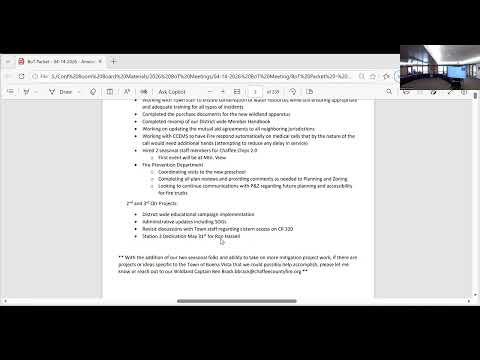
On equipment, Kira said two new wildland truck chassis had been ordered and are expected to be delivered far sooner than typical apparatus lead times — possibly by December of this year. One truck will remain in the district as a primary local resource when not on national incident dispatch;
The department is also reviewing mutual‑aid agreements with nearby agencies and reported progress on emergency medical dispatch (EMD) cards and a new dual‑paging procedure with EMS to page fire and EMS concurrently for specific call types that require both resources. Kira described an expanded JP CHIPS mitigation model that spends more time in neighborhoods (up to 10 days versus previous three‑day events) to provide 1‑on‑1 homeowner mitigation assistance and pile pickups.
Kira closed by asking trustees to be mindful of planning topics that affect fire access and parallel parking dimensions for new development and said the department would continue community engagement and public education on mitigation and seasonal programs.
What’s next: trustees will continue coordination with fire staff on development standards for access and parking and support community education tied to wildfire mitigation.