Get Full Government Meeting Transcripts, Videos, & Alerts Forever!
Get email alerts on the CHNA topic
No spam. Unsubscribe anytime.
Mesa County health staff plan a 2027 CHNA, emphasize survey continuity and representativeness
Summary
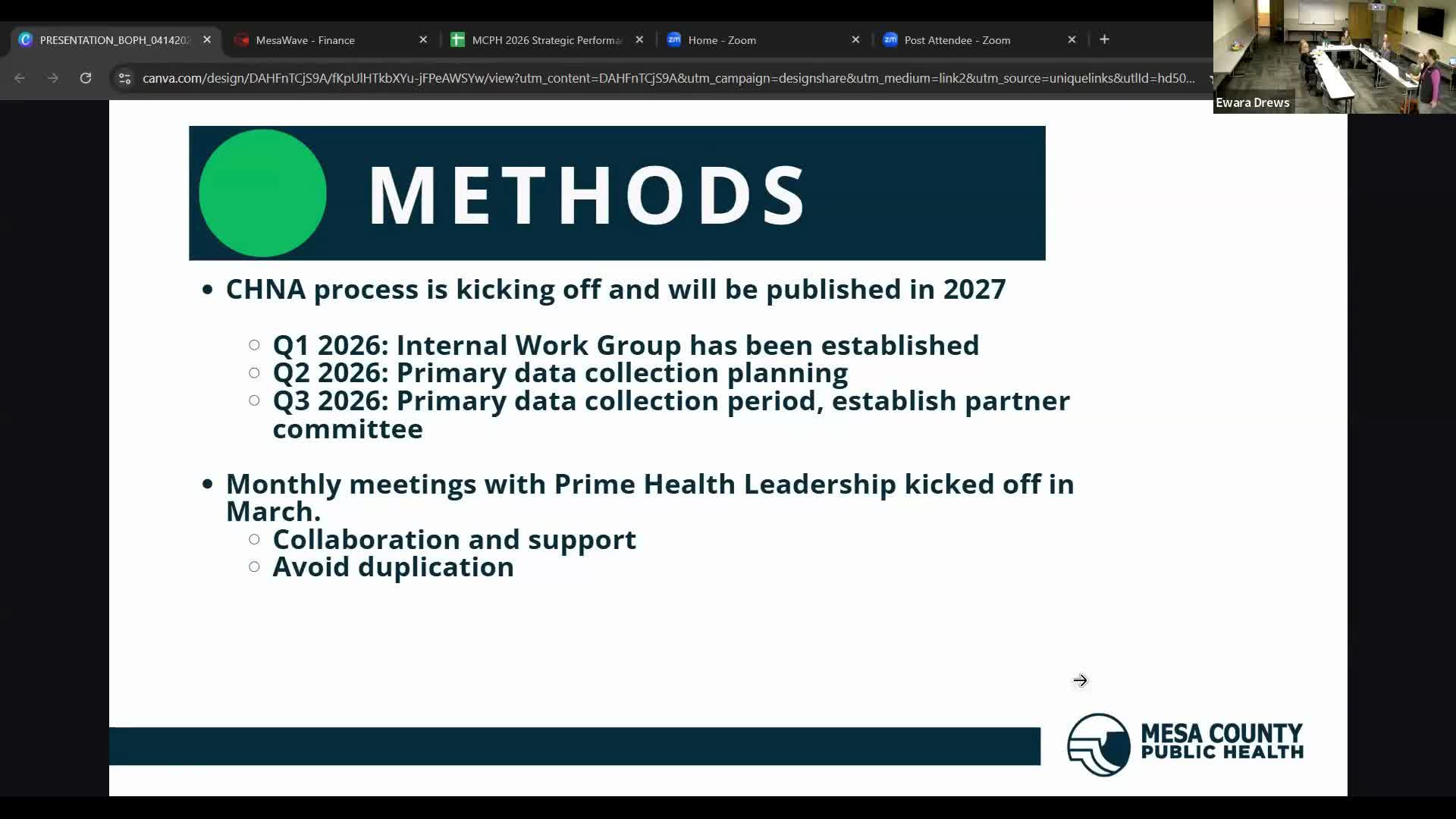
Alice Ireland, data and informatics manager, told the board the Community Health Needs Assessment will be planned in 2026 and published in 2027; staff plan to reuse key TELUS questions for continuity, limit survey length, and coordinate with county and municipal surveys to reduce duplication.
Alice Ireland, data and informatics manager, told the Mesa County Board of Public Health that the agency’s Community Health Needs Assessment (CHNA) planning will take place this year and the agency expects to publish the CHNA in 2027. Ireland said the CHNA timing aligns to statutory requirements but that the county partners typically coordinate on a three-year cadence with local hospitals, and the agency is intentionally preserving continuity with prior surveys to enable trend comparison.
"We plan not to publish that until 2027," Ireland said, adding that staff want to retain question continuity so key indicators can be compared with the prior survey. She flagged concerns about the prior telesurvey’s length and sample skew—"it took probably like 40 minutes" and responses over-represented middle-aged white women—and said staff aim for a substantially shorter instrument (five to 10 minutes preferred) and targeted outreach to reach underrepresented populations across Mesa County.
Board members asked whether partner committee input should be solicited before finalizing primary-data questions; Ireland said the agency will form an internal workgroup to preserve question continuity and then involve a partner steering committee for distribution planning and representation. Ireland also said staff will look for existing local surveys (for example, a recent Grand Junction housing survey) to avoid duplication.
Why it matters: the CHNA informs the community health improvement plan (CHIP) and local priorities such as behavioral health and economic stability. Staff said some CHNA questions are mandated for benchmarking, while others are selected to maintain longitudinal comparability.
What’s next: staff will prepare a steering/partner committee for distribution planning, prioritize shorter surveys to reduce respondent fatigue, and share updates with the board through standing reports.