Get Full Government Meeting Transcripts, Videos, & Alerts Forever!
Get email alerts on the Land Use Solar topic
No spam. Unsubscribe anytime.
Clinton County amends subdivision and zoning rules to tighten solar development standards and require decommissioning bonds
Summary
The Clinton County Board of Commissioners approved amendments to the county’s subdivision and zoning ordinances to add definitions for accessory and principal solar energy systems, establish setbacks and conditional-use review, and require decommissioning plans and bonding to prevent abandoned solar installations.
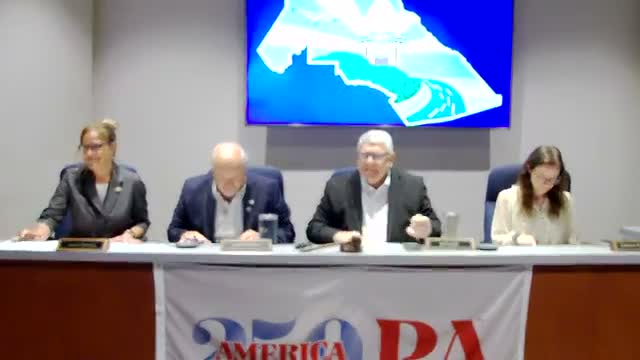
The Clinton County Board of Commissioners on May 7 approved ordinance amendments that add detailed standards for solar energy systems, including requirements for decommissioning bonds and conditional-use review. County planner Mr. Gibson told the board the changes expand the previous one-page guidance into roughly 10 pages of definitions, design standards and bonding rules to ensure large solar arrays are removed when they reach end-of-life.
The ordinances distinguish accessory solar systems — small arrays for on-site use — from principal energy systems that sell power to the grid, Mr. Gibson said. “What was missing from the subdivision land development ordinance were definitions of the difference between accessory solar… and principal energy solar energy systems,” he said, and the new language covers how to design systems, prepare plans, and “how to decommission them and bond them for when they’re eventually gonna be taken out of service.”
The zoning amendment replaces an existing 2016 section and adds clearer rules about where principal solar systems can be sited, minimum distances from residential structures, and the use of conditional-use hearings so the county can require screening or other mitigation in sensitive locations. Mr. Gibson said many municipalities in the county have already adopted similar provisions and that the county could provide the new language as a model for municipalities that administer their own zoning.
Commissioners characterized the changes as protections against future blighted, abandoned installations and as a tool to balance renewable development with local land-use concerns. A commissioner noted that decommissioning and bonding are among the most important elements: without them, “these things aren’t just sitting around rotting 25 years from now,” Mr. Gibson said.
Mr. Gibson also flagged emerging questions about data centers and artificial-intelligence–related development, saying staff may return to the board with zoning proposals on those topics in coming months. The board voted to approve the ordinance reading and proceeded with the related zoning replacement measure.
The planner’s presentation and the commission’s approval move the county toward formal adoption; any additional administrative steps or hearing schedules were not specified at the meeting.