Get Full Government Meeting Transcripts, Videos, & Alerts Forever!
Get email alerts on the West Greeley Financing topic
No spam. Unsubscribe anytime.
West Greeley project faces large financing gap; council presses staff on models and public communication
Summary
City staff and advisors told council updated costs for the West Greeley project have risen and that refined financing assumptions leave a remaining gap (discussed by council around $127 million). Staff emphasized multiple scenarios, the need to refine GID/COP assumptions and the oversight committee’s role; council members urged clearer public explanations.
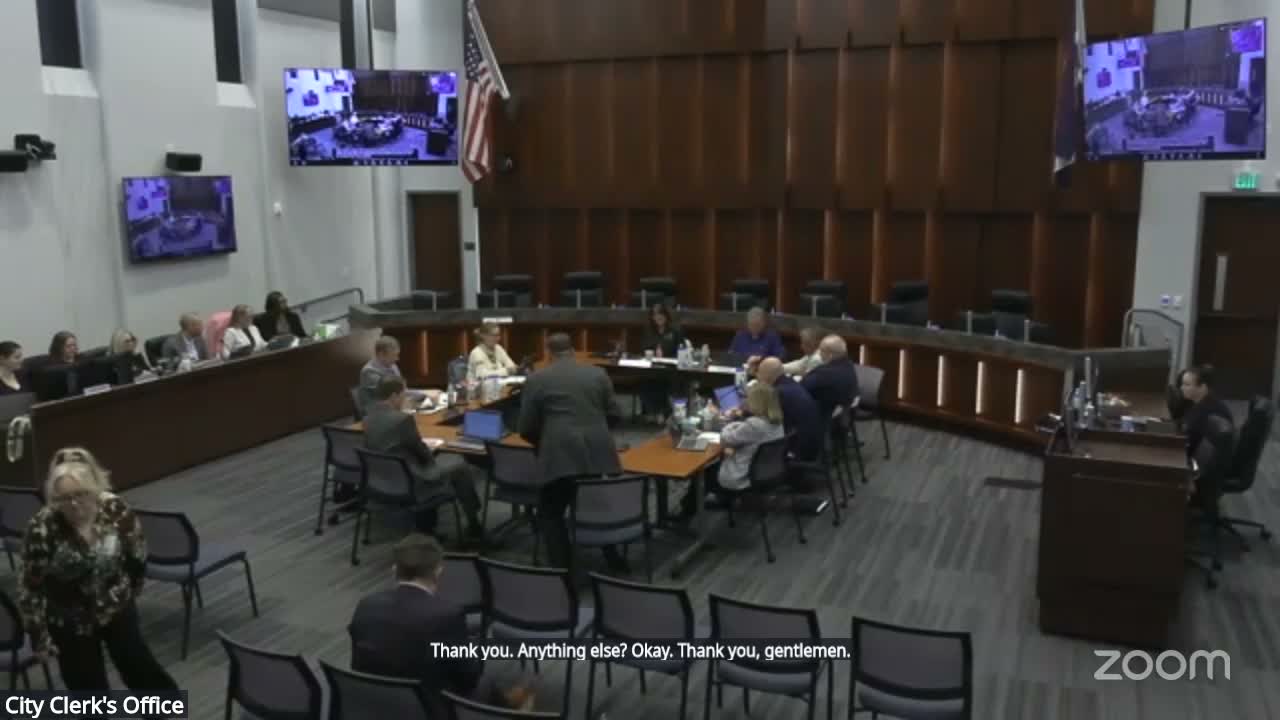
City staff and outside advisors briefed the Greeley City Council on updated cost estimates and financing options for the West Greeley project during the April 2026 work session. Staff presented a preferred option cost estimate of approximately $959,400,000 (February 2026 figure) and noted an additional roughly $211,000,000 of capitalized interest, issuance costs and required reserves under the current modeling assumptions.
Alina Fortis (staff) and Jason Simms of Hilltop Securities reviewed the changed structure for predevelopment financing. Staff said the earlier $115 million certificate of participation (COP) plan had been revised and the current predevelopment COP contemplated in the presentation was roughly $90 million focused on 100% design, grading and the Boyd waterline work. That change reflects a lower estimated GID bond capacity and shifts more short‑term refinancing exposure onto the city if reimbursement assumptions do not materialize.
Advisors warned the council about non‑appropriation risk: a prior negative vote has increased investor concern about the city’s willingness to make annual appropriation decisions tied to economic‑development payments and debt‑service reserve replenishment. Jason Simms explained that investors price that political uncertainty into rates, which can raise interest costs and reduce available bonding capacity.
Council members pressed for clarity on model differences. One council member said multiple consulting models (CBRE, HNLA, RBC/others) produced divergent results and that the council needs a single baseline or a transparent way to compare assumptions. Council debate also highlighted a projected debt‑service spike in later years under some scenarios and the practical difficulty of funding startup and reserve requirements up front.
Brett Naber provided an approximate balance figure for the Western Sugar tax increment district during the discussion ("roughly around $25,000,000"), and staff noted that regional partners had indicated potential contributions (about $11,500,000) toward a CR 17 interchange pending intergovernmental agreements. Staff repeatedly cautioned that many figures remain preliminary and contingent on updated models, legal structures and partner commitments.
Council directed staff and the oversight committee to focus on clearer public communications, run consistent baseline models, and return with refined assumptions and options for narrowing the financing gap, including alternative partner structures and phased approaches to off‑site improvements.