Get Full Government Meeting Transcripts, Videos, & Alerts Forever!
Get email alerts on the Early Childhood Workforce topic
No spam. Unsubscribe anytime.
Montgomery County hearing outlines crisis in early‑childhood workforce and calls for regulatory fixes, new funds
Summary
County officials, educators and community partners told a Montgomery County Council work session that the early childhood care workforce is in crisis — citing seat losses, low wages, and a frozen credential program — and proposed regulatory streamlining, scholarships, a $4 million facilities fund and state advocacy.
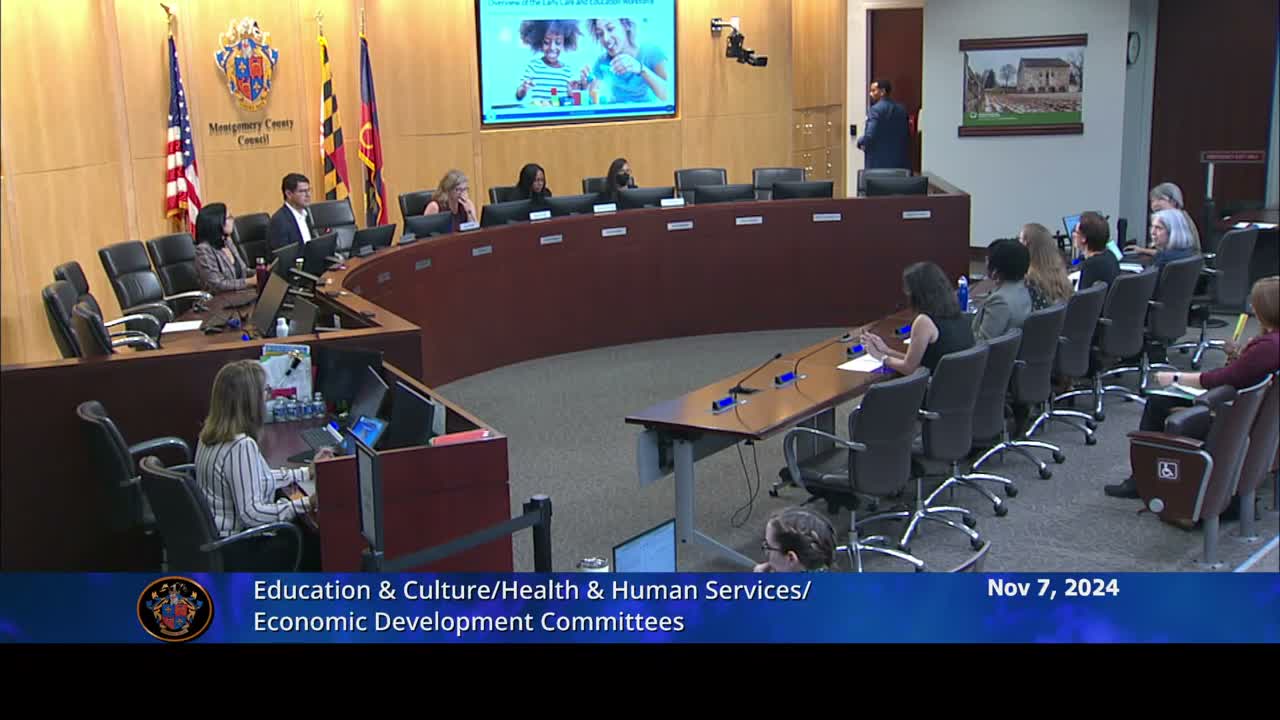
Montgomery County Council hosted a multi‑agency work session on early childhood care and education workforce shortages, where local officials, Montgomery College, county health and human services and community partners presented data, supports and a set of recommendations for state and local action.
Kimberly Resnick, executive director of the Children’s Opportunity Alliance, said Maryland’s early childhood workforce ‘‘has not recovered post pandemic,’’ citing a loss of about 22% of the workforce since 2020 and placing the state near the bottom of a national workforce index. Resnick said declining provider capacity in Montgomery County has reduced seats — particularly in family child care homes — and pointed to a freeze this fiscal year in the state credentialing program as a lost investment in workforce development.
The presentations outlined specific numbers and conditions county leaders said matter to families and employers. Resnick noted research on early brain development and argued public investment is necessary: ‘‘Every dollar invested in an individual has a higher return on investment the earlier it is invested,’’ she said. County staff added that the state median wage for the ECE workforce was about $14.17 an hour in 2022 and that many childcare workers earn roughly $32,000 a year, compared with much higher pay for MCPS teachers.
Montgomery College described education and credential pathways that feed the workforce, including associate and applied science degrees, alternative certification for degree‑holding professionals, and ECEI scholarships that the college said have provided more than $1.6 million in support since 2019 and helped more than 600 students. Sarah Campbell, interim vice president for liberal arts and education, noted the removal of a previous $5,000 cap on ECEI scholarship awards, allowing students to take additional classes and pursue credentials at a more flexible pace.
Nichelle Owens of Montgomery County Public Schools reviewed MCPS pathways for pre‑K educators and paraeducators and said the district is monitoring a state timeline for higher credential requirements that MSDE delayed to FY 2027. Owens said MCPS is assessing which paraeducators will need credentials and working with human resources and higher‑education partners to support staff while guarding against incentives that might push workers to other classrooms.
Jennifer Arnais of the county’s Department of Health and Human Services described county training and program supports: roughly 8,000 educators took free or reduced training in FY24, coaching and technical assistance aim to raise programs to Maryland EXCELS levels 3–5, and the county plans a $4,000,000 facility improvement fund offering zero‑interest, forgivable loans to expand and upgrade program space. Arnais also described a shared‑services model and a business‑counseling effort that assisted about 230 family child care programs; she said an ECRA care grant presently covers roughly 77 children and provides an upfront reimbursement mechanism.
Anise Cody, co‑chair of Montgomery Moving Forward, presented six broad recommendations the cross‑sector group prioritized, beginning with regulatory simplification, elevating early care and education as an economic policy issue, and expanding the coalition of business, philanthropy and nonprofit partners. Cody said MMF planned stakeholder convenings in November and December (the panel later confirmed Nov. 19 and Dec. 5) that will include state legislators and state agency staff to identify what requires legislative change versus administrative fixes.
Council members used the session to press for specifics and next steps. Chair Fani Gonzalez asked how the county will work with the state delegation on credential and licensing modernization; MMF said the convenings will produce a foundation for recommendations but that draft legislation had not yet been written. Councilmembers asked Montgomery College for enrollment and retention figures for its ECE pipeline, which college staff said they would report back on, and asked DHHS about updating the county cost‑of‑care study; county staff said the contract calls for an update in two years and that an action plan to reimagine subsidy design will follow in the new year.
Members also raised operational concerns: differences between licensing (health and safety) and Maryland EXCELS (program quality), application processing delays at the Maryland State Department of Education Office of Child Care, possible ‘‘seat cannibalization’’ where pre‑K expansion could displace infant‑toddler slots, and the need to support small family providers. County staff said they are exploring policy levers to expand seats rather than convert existing infant/toddler capacity and will use supply‑and‑demand studies to guide siting of future public childcare in county facilities.
The session produced no formal motions or votes. Panelists said next steps include the MMF stakeholder meetings in November and December, an action plan and worker‑support strategies due in the new year, and further outreach by Montgomery College and county offices to expand training and recruitment. The work session adjourned after the partners agreed to share meeting dates and follow up with the full council.