Get Full Government Meeting Transcripts, Videos, & Alerts Forever!
Get email alerts on the Childcare Supply Demand topic
No spam. Unsubscribe anytime.
County studies find roughly 23,000-seat child-care shortfall; infants and toddlers hardest hit
Summary
Consultants told a joint Montgomery County committee that the county has about 57,300 children under 5 and capacity for roughly 33,600 seats, leaving an estimated gap of 23,000 seats; infant and toddler care meets only about 19% of local need, the presenters said.
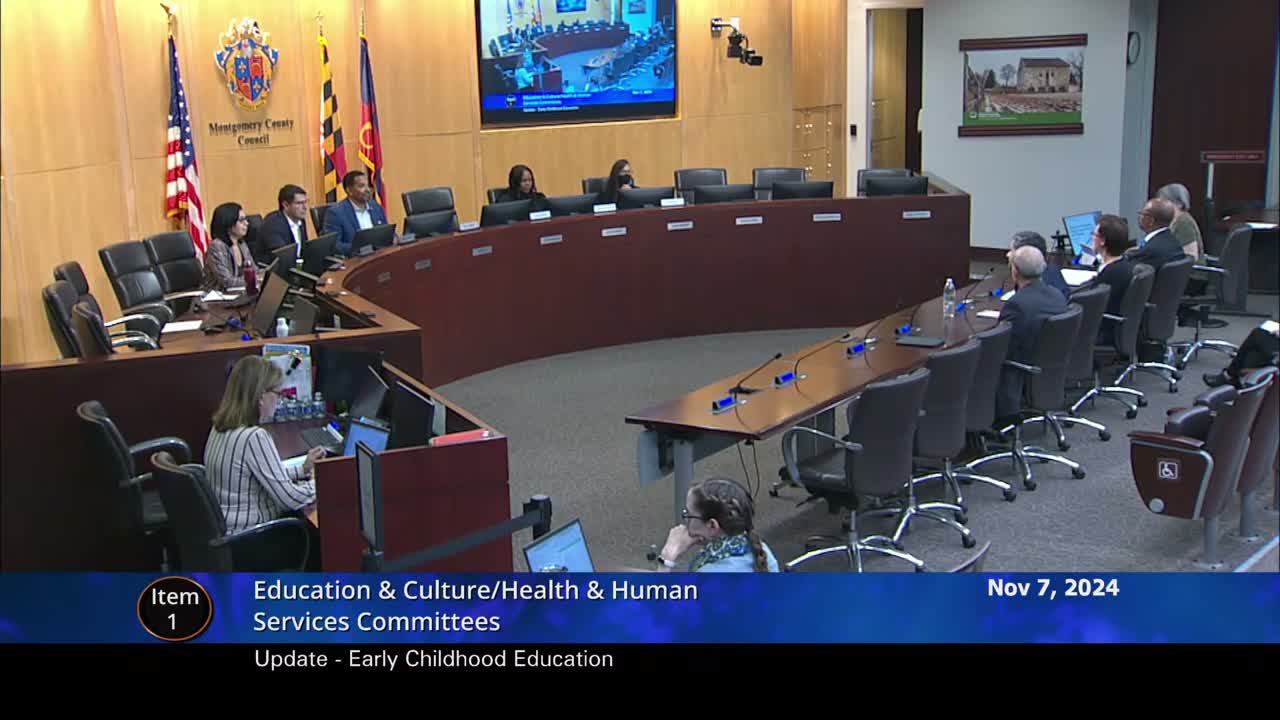
At a Nov. 7 joint meeting of Montgomery County’s Education, Culture, Health and Human Services Committee, consultants presenting a county supply‑and‑demand study said the county faces a roughly 23,000‑seat shortfall in formal child care, and the shortage is most acute for infants and toddlers.
"Overall, we estimate there's about 57,300 children who might be looking for care in the county," Jacob Roche of the Reinvestment Fund told the committee, summarizing the study's demand estimates. Roche said the county's formal-care capacity was estimated at about 33,600 seats, producing a gap of roughly 23,000 seats.
The study found major variation by age: coverage for children ages 2–5 is near 83 percent, whereas capacity for infants and toddlers (under 2) meets about 19 percent of estimated need, Roche said. He also reported an estimated 4,300 infant/toddler seats among the county’s total capacity.
The presenters highlighted subsidy participation as an additional constraint. Roche said about 21,000 seats across programs could participate in the state Child Care Scholarship (CCS) system but only about 4,000 children were using those seats; similarly, roughly 9,200 seats participate in the county’s Working Parents Assistance (WPA) program but only about 940 children were enrolled in those WPA seats. "The county has a lot more, sort of, unused capacity in these subsidized programs," Roche said.
Consultants said affordability, program hours and language access drive family choices. Roche summarized qualitative work including surveys and focus groups: many families can find a program, but face information gaps about enrollment and subsidy eligibility. He noted that 74 percent of children under 5 live in households with two working parents and about 55 percent of children are income‑eligible for WPA or CCS.
The report includes geographic shortage maps the consultants said can guide targeted investments. Roche described different market types — places that need new seats, places where existing providers could expand infant/toddler offerings, and places where business‑model adjustments could yield more infant/toddler capacity.
County staff said the studies will be publicly released in January and that the department will work with stakeholders to build an action plan by the end of the fiscal year. Staff also outlined a planned $4 million facilities fund (RFP to be released in January) intended to support capital expansion and quality improvement for programs in targeted neighborhoods.
What happens next: the presenters recommended using the shortage maps to prioritize where county subsidies and capital funds should go, focusing strongly on infant and toddler capacity while improving outreach and enrollment processes to boost participation in existing subsidized seats.