Get Full Government Meeting Transcripts, Videos, & Alerts Forever!
Get email alerts on the HB603 Digital Assets Gold topic
No spam. Unsubscribe anytime.
House committee advances constitutional amendment to allow state investment in gold and digital assets; members warn about Bitcoin exposure
Summary
HB603 would amend the constitution to authorize state investments in precious metals and 'digital assets.' The Civil Law Committee reported the measure favorably on a 5–3 roll call after lawmakers questioned whether Bitcoin or pensions would be exposed and asked how implementation would be controlled.
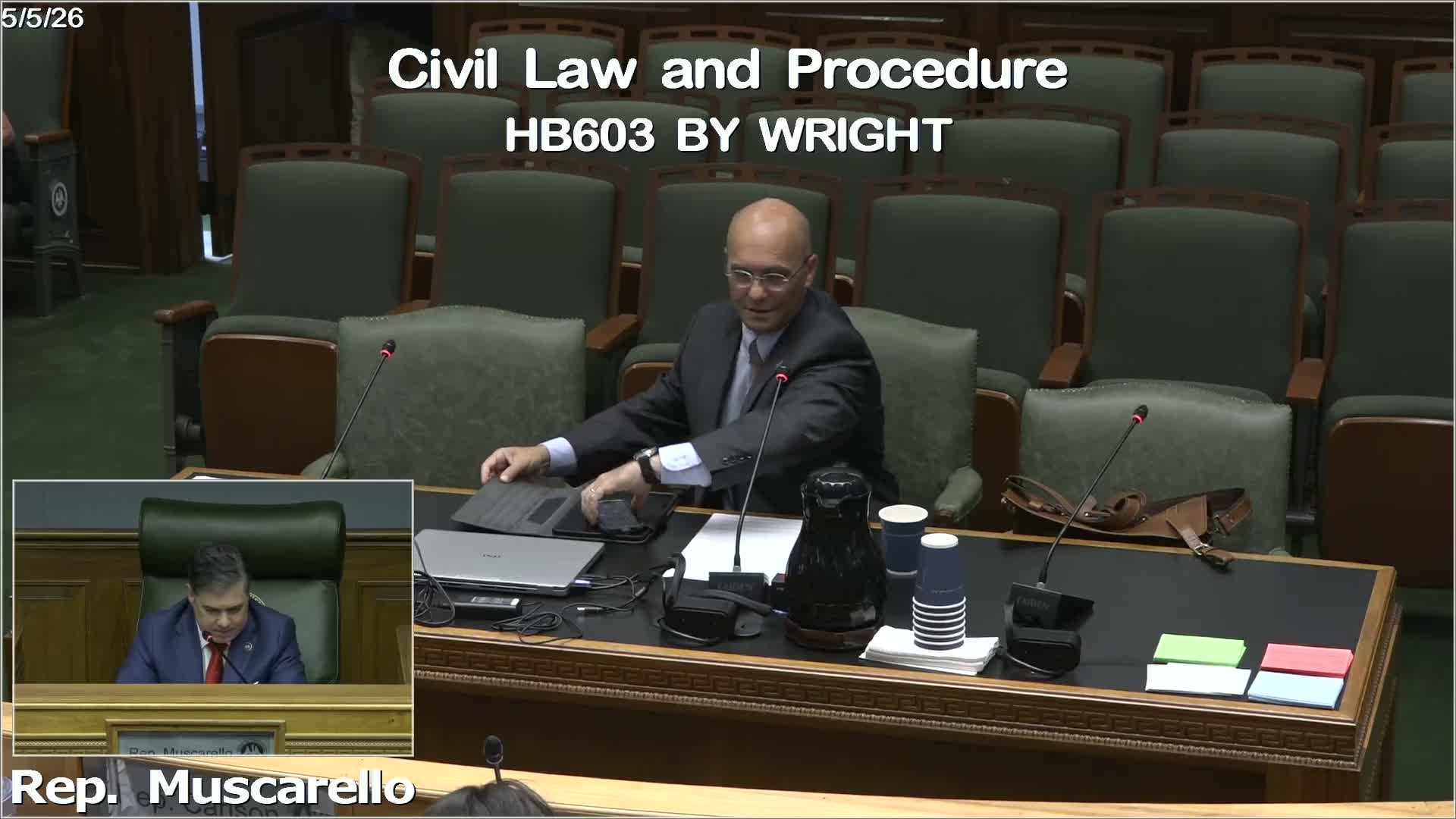
The Civil Law Committee voted 5–3 to report HB603, a constitutional amendment sponsored by Representative Wright that would authorize the state to invest public funds in precious metals and certain digital assets pending statutory implementation.
Representative Wright told the committee the amendment is ballot language intended to allow the state to hedge against long‑term dollar devaluation by permitting investments in gold and tokenized or other digital assets; he said details about what specific instruments would be allowed and how they would be managed would be set later by statute and by the treasurer or the legislature.
"This is simply giving the state an opportunity to... invest money into gold or digital assets," Representative Wright said while urging prudence in how the authority would be implemented.
Representative Wilford Carter pressed whether the measure would permit the state to invest in Bitcoin; Wright said that while Bitcoin is a type of digital asset, the ballot language is broad and statutory detail would determine permissible investments, and he expressed skepticism that Bitcoin itself would necessarily be the chosen vehicle. (Representative Wilford Carter, question; Representative Wright, response)
Representative Glorioso asked whether the amendment by itself would allow investments without a companion statute. Wright said the constitution would provide authority but acknowledged uncertainty about whether statutory follow‑up would be required to define procedures; he said he was open to drafting clarifying language if members preferred.
Representative Taylor asked about oversight and whether pensions and retiree funds would be put at risk; Wright said investment decisions would be public record, that the state treasurer or other designated authority would manage active funds, and that any allocations would likely be a modest percentage intended as a hedge, not a major exposure.
Ms. Alonzo read the draft 6.8A report that lists the proposed constitutional change to Article 7, Section 14(b) and sets the proposed election date as Nov. 3, 2026. The committee recommended reporting HB603 without amendments; a roll call followed and the motion passed 5 yeas to 3 nays.
The committee record shows the measure was reported favorably and will proceed to subsequent legislative steps, with statutory detail and oversight mechanisms to be worked out if voters approve a constitutional amendment.