Get Full Government Meeting Transcripts, Videos, & Alerts Forever!
Get email alerts on the Special Education Funding topic
No spam. Unsubscribe anytime.
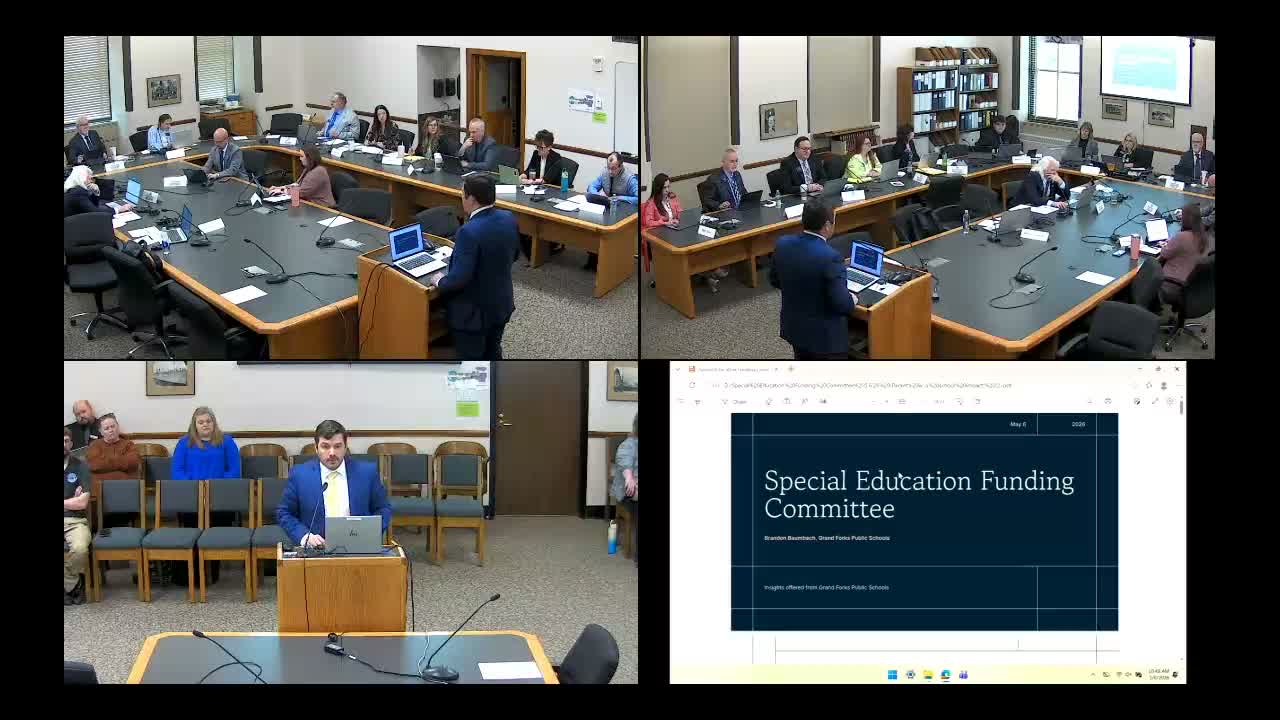
Lawmakers debate special‑education funding after Grand Forks warns of growing local burden
Summary
School finance officials and lawmakers discussed options to narrow a widening gap between special‑education expenditures and state formula support: lowering the excess‑cost threshold, raising the special‑education weighting factor, or moving to a cost‑reimbursement model; DPI agreed to run fiscal scenarios.
A legislative committee spent more than two hours examining why special‑education spending in some districts has outpaced state formula support and discussed three reform paths to close the gap: lower the excess‑cost threshold, increase the special‑education weighting factor, or move to cost‑based reimbursement.
Brandon Bombach, business manager for Grand Forks Public Schools, told the committee that Grand Forks’ students served on individualized education programs increased roughly 44% between 2015 and 2025 while state formula support grew at a much slower rate. “When the special education count went up, but the total population went down, we saw increased costs for the district without additional support,” Bombach said, illustrating how his district’s local share of special‑education costs has risen sharply.
Bombach recommended exploring a cost‑based reimbursement model tied to documented IEP costs and student placements to ensure funds follow student needs, and he emphasized accountability: “If you had a cost based reimbursement through student contracts… you'd have a lot more accountability specific to students rather than a generic funding formula.”
Representative Carla Rose Hansen presented two narrower options drawn from a Wapenton school district analysis: reduce the statutory high‑cost threshold from four times the state average to 3.0–3.5 times (so more students qualify for excess‑cost reimbursement) or raise the special‑education weighting factor (she cited an example increase from 0.088 to 0.174 in district modeling). Hansen and Bombach both asked DPI for fiscal impact estimates.
Adam Tesher, DPI school finance officer, said the 4× threshold and the “top 1%” rule are statutory (NDCC 15.1‑32‑18) and reported DPI’s early modeling: moving the multiplier to 3.5× could increase biennial reimbursements modestly (DPI’s back‑of‑envelope: roughly $1.2M additional annually in student‑contract reimbursements, depending on how many students fall between 3.5× and 4×). Tesher cautioned that many districts do not reach the current 1% excess‑cost cap and that Medicaid and other third‑party payments are factored into DPI’s calculations to avoid double‑dipping.
Committee members raised tradeoffs. Several legislators warned that simply increasing state reimbursement without program changes might not improve student outcomes; others said a cost‑reimbursement model would be fairer but more administratively complex and potentially expensive. Rural district representatives said they have less flexibility to reallocate local budget funds and already lack options to cut non‑mandated programs.
The committee asked DPI to prepare scenario modeling and fiscal notes (including estimates of how many additional students would qualify under alternate thresholds and the general fiscal impact of raising the weighting factor) for the next meeting so members could weigh equity, administrative burden and appropriation tradeoffs.
The discussion ended with no final decision; members indicated willingness to consider targeted statutory changes (threshold or weighting adjustments) if DPI’s numbers showed manageable fiscal impacts and reasonable distributional effects across districts.