Get Full Government Meeting Transcripts, Videos, & Alerts Forever!
Get email alerts on the Transboundary Mining topic
No spam. Unsubscribe anytime.
Lawmakers hear competing views on British Columbia mines’ risks to Alaska’s transboundary salmon rivers
Summary
The Alaska House State Affairs Committee heard agency updates and stakeholder testimony May 5 on transboundary mining, with state officials reporting no detected contamination on the U.S. side while tribal, conservation and fishing groups urged stronger bonding, notification and binding international protections for shared salmon watersheds.
Juneau — The House State Affairs Committee on May 5 held an extended presentation and stakeholder panel on transboundary mining and its potential risks to Southeast Alaska salmon rivers.
State officials told the committee that existing bilateral cooperation with British Columbia has produced technical coordination and stronger provincial bonding requirements, but stakeholders urged more robust, binding protections and earlier involvement in foreign permitting. "The memorandum of understanding and statement of cooperation established in 2015 created a bilateral working group and technical teams," Alaska Department of Fish and Game Commissioner Doug Vincent‑Lang said. He added that Alaska and BC agencies now meet regularly, and that Alaska monitoring has not detected water‑quality violations on the U.S. side of the border.
Stakeholder groups contested parts of that assessment. Brianna Walker, director of Salmon Beyond Borders, said pollution events have occurred on the BC side and raised concern that some BC permits may allow discharges above allowable levels. "There are pollution events at the Premier Mine and other projects less than 20 miles from the Alaska border," Walker said, and urged the state to seek full reclamation bonding, transparent notifications to Alaskans and a binding international agreement under existing frameworks such as the United States‑Canada Boundary Waters Treaty or the Pacific Salmon Treaty.
Paulette Moreno, vice president of the Central Council of Tlingit & Haida, told the committee tribes are not consistently receiving technical comments, notifications or meaningful consultation and called for "no‑go zones," full bonding and monitoring practices grounded in Indigenous knowledge. "These rivers are our food systems, our economies, and our identity," Moreno said, urging a pause on new transboundary mines until protections and consultation are guaranteed.
Technical witnesses described process gaps that can limit Alaska's influence on BC permitting. Steve Buckley, chief of the mining section at the Department of Natural Resources and a member of the transboundary technical advisory committee, said legacy sites such as the Tulsequah Chief require complex remediation work and that BC has updated financial assurance rules that now more closely mirror Alaska's bonding model. Dr. David Chambers of the Center for Science and Public Participation warned that if ADNR cannot commit the staff and funding to participate in BC's cooperating‑agency meetings, Alaska loses the opportunity to influence major project design elements and permit conditions.
Conservation and fishing groups emphasized scale and economic stakes. Brian Lynch (Rivers Without Borders) highlighted the proposed KSM project and its projected volumes of overburden and tailings, warning the mine would generate extraordinary waste streams requiring ongoing treatment. Linda Behnken of the Alaska Long Line Fishermen's Association called out the fisheries' economic importance for Southeast Alaska and urged the state to advocate for safeguards and financial assurances.
When asked about monitoring history, Commissioner Vincent‑Lang said the bilateral monitoring programs have been in place for roughly 10 years and that DEC and partner agencies publish annual transboundary water‑quality reports; he also noted a three‑year, $318,000 EPA grant to support aquatic biomonitoring on four major transboundary systems (Taku, Stikine, Unuk and Salmon Rivers) and that field sampling began this spring.
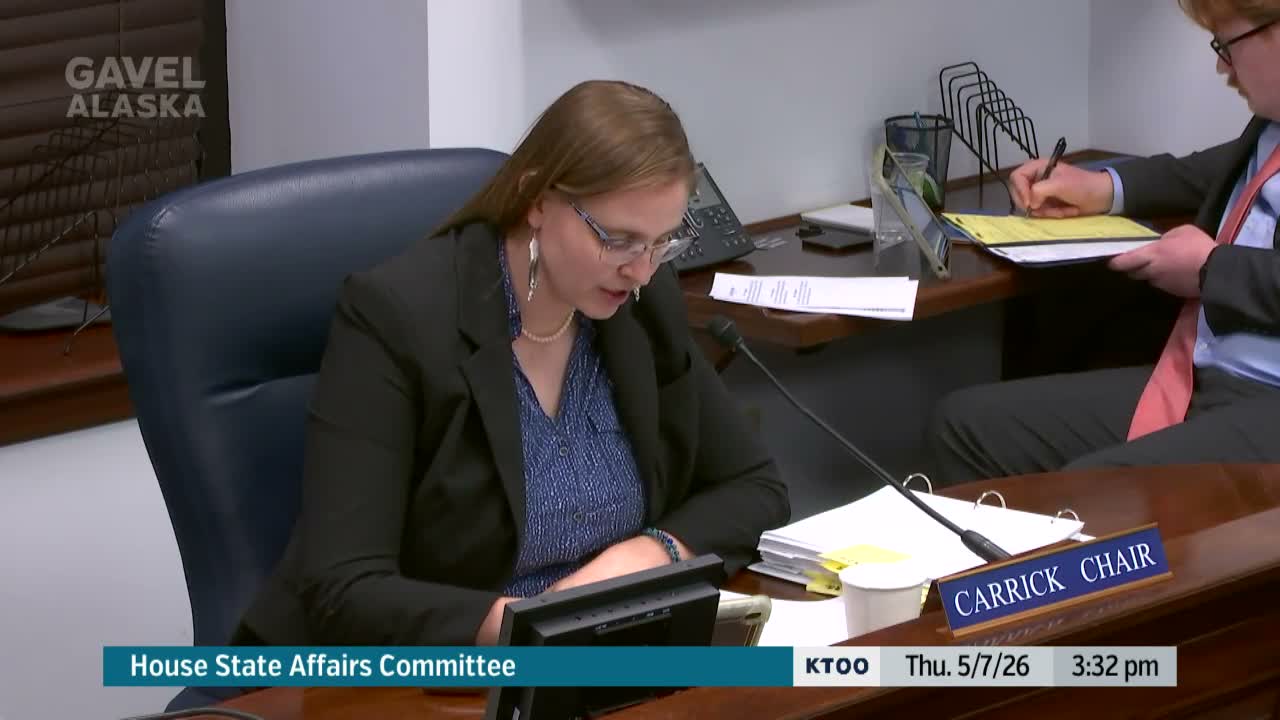
Committee members acknowledged the disparity in perspectives—state scientists report no detected contamination on the U.S. side, while stakeholders point to pollution incidents and permit concerns on the BC side—and Chair Eric Carrick said the hearing underscored a need for more consultation, regional coordination, and clearer information sharing. "The concerns downstream are very real," Carrick said, while also noting that monitoring to date has shown minimal impact within Alaska.
The committee invited additional materials and suggested that, if the topic continues next year, the committee would welcome testimony from mining companies and further technical materials from stakeholders and agencies. The hearing concluded without any formal action on state-level legislation; committee members signaled they may pursue more comprehensive approaches in future sessions.
Sources and attribution: Quotes and details are drawn from sworn testimony and remarks on the record to the House State Affairs Committee on May 5, 2026. Key speakers on the record include Commissioner Doug Vincent‑Lang (Alaska Department of Fish and Game); Steve Buckley (DNR mining chief); Brianna Walker (Salmon Beyond Borders); Paulette Moreno (Central Council of Tlingit & Haida); David Chambers (Center for Science and Public Participation); Brian Lynch (Rivers Without Borders); Linda Behnken (Alaska Long Line Fishermen's Association); and members of the House State Affairs Committee.