Get Full Government Meeting Transcripts, Videos, & Alerts Forever!
Get email alerts on the Groundwater Remediation topic
No spam. Unsubscribe anytime.
Agency official says air‑stripping now treats East Trenches plume at Rocky Flats
Summary
An agency official described replacing granular iron with a compact air‑stripping system at Rocky Flats’ East Trenches Plume Treatment System, consolidating plume treatment, running the unit off solar‑charged lithium batteries, and meeting RFLMA effluent standards while treating roughly 1.4–1.5 gpm.
An agency official described how the East Trenches Plume Treatment System (ETPTS) at Rocky Flats was reconfigured to treat groundwater from multiple plumes and now uses air stripping rather than granular zero valent iron (ZVI).
The official said the site collapsed four original treatment systems to three by routing water from the former Mound Site Plume to ETPTS so the same treatment system can handle both plumes. “Air stripping is the one we landed on,” the official said, explaining that air stripping provided a compact, reliable option suited to the low flows the site currently receives.
Why it matters: The Rocky Flats Legacy Management Agreement (RFLMA) sets strict effluent requirements for treated groundwater. The presenter said the original ZVI systems could not consistently meet those standards and that replacing the ZVI media was operationally difficult and resource intensive.
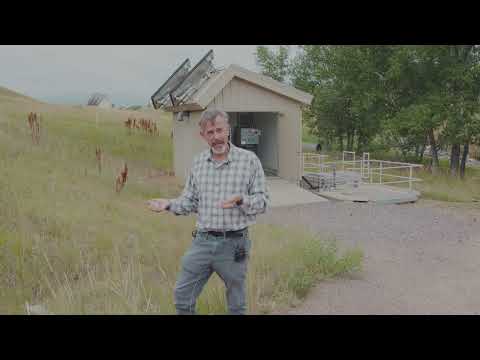
The presentation detailed how the system operates. The speaker said ETPTS runs in batch mode, typically processing water collected overnight when there is sufficient electrical power and water volume. In July the system’s 24‑hour average was “about 1.4 to 1.5 gallons per minute,” and daily throughput was about “2,400 to 2,500 gallons per day.” The system is off the electrical grid, the official said, and the air stripper is powered by lithium iron phosphate batteries recharged by a bank of solar panels housed in a Conex container.
The speaker described the treatment process: stacked trays in a glass‑fronted air‑stripping unit force air up through the water so volatile organic compounds (VOCs), including chlorinated solvents, transfer into the gas phase and exit through a vent. The official emphasized that ‘‘volatile’’ describes a compound’s tendency to evaporate and does not by itself mean the compound is flammable.
The briefing covered site hydrology and collection infrastructure. A buried perforated pipeline intercepts contaminated groundwater upgradient of South Walnut Creek and routes it to ETPTS for treatment; the former Mound Site collection infrastructure remains and now pumps to ETPTS. Treated water is discharged to a second tank and then to the subsurface, subject to RFLMA limits to avoid adverse impacts on South Walnut Creek surface water.
The presenter contrasted the new system with the previous ZVI approach. ZVI media required three semi loads from Detroit for replacement every few years, the official said, and over time the granular iron cemented into solid blocks that were difficult and hazardous to remove from 8–10 foot tanks. That removal required a mini‑excavator and manual hand‑loading operations via ladders, creating safety, cost and carbon‑footprint concerns. By contrast, the consolidated ETPTS has been “essentially glitch free since we put it in,” the speaker said, and requires only modest maintenance.
The presenter also noted related site infrastructure, including a pre‑closure B Pond bypass pipeline visible on site that allowed routing water around now‑removed impoundments; only Terminal Pond B5 remains. He reiterated historical context: chlorinated solvents were commonly used on site for machining and cleaning in the mid‑20th century and were sometimes disposed in earthen trenches, a practice now known to contaminate groundwater.
The presentation did not include formal decisions or votes. The official characterized the changes as operational improvements that allow the site to meet RFLMA standards while reducing the logistical, safety and environmental burdens of prior media replacement.