Get Full Government Meeting Transcripts, Videos, & Alerts Forever!
Get email alerts on the Elections topic
No spam. Unsubscribe anytime.
Madison County panel dismisses residency and petition objections to Josh Haynes’s nomination
Summary
A panel of elected officials in Madison County dismissed objections to Josh Haynes’s nomination for supervisor, rejecting a residency challenge after reviewing permits and a 911 assignment and concluding Haynes met the petition‑signature requirement after verification.
A panel of elected officials in Madison County on March 31 dismissed two formal objections to Josh Haynes’s nomination for supervisor for District 1, ruling that the evidence presented did not disqualify him from the ballot.
An election official reading Iowa Code 48A.5 described the residency standard — domicile requiring physical presence and a fixed place of abode — and noted items staff found during a records check, including a 911 address marker and a septic construction permit filed March 11. The official said certain facts raised questions about whether a camper or mobile home on the property constituted a permanent dwelling under county code, citing requirements such as hookups, inspections and building permits. “A person’s residence is defined as a place the person considers their home and intent to remain,” the election official said while summarizing the statute and related permitting records.
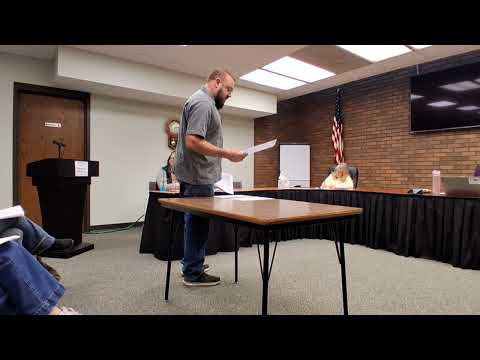
The candidate, Josh Haynes, presented zoning applications, a temporary dwelling permit, a zoning certificate for a house under construction, a septic permit, the field‑entrance and 911 assignment paperwork and vehicle registration tied to the property. “It’s our house. We started this process before we sold our last house in St. Charles … we live out there full time,” Haynes said, adding that wastewater has been hauled to a certified campground dump station while the permanent septic work is completed.
Panel members asked clarifying questions about purchase and assessment dates, when permits were applied for and whether inspections were finished. Staff confirmed the 911 address assignment and that assessment and tax records can lag construction. After hearing the evidence and discussion, a panel member moved to dismiss the residency objection; the facilitator announced the motion was dismissed after a roll call in which one member voiced opposition and another abstained.
The hearing then turned to challenges to specific petition signatures. Staff and panel members examined signature pages and identified entries that appeared to be out of district, duplicates and entries that could not be verified by signature alone; those obvious out‑of‑district signatures were marked for exclusion while ambiguous entries were scheduled for verification against voter records. The objector asserted only 22 valid signatures remained; campaign representatives and staff said Haynes had verified roughly 80–81 names.
There was some confusion in the record about the numerical threshold required (a prior practice of 50 signatures was cited and guidance about population‑based thresholds was discussed). Panel members and election staff repeatedly referenced the candidate guide and state guidance while validating the submitted names. After verification and discussion the panel moved to dismiss the petition‑signature objection; the facilitator announced the motion carried and confirmed Haynes will remain on the ballot.
The hearing record shows the panel relied on documentation in the record — permits, a 911 assignment and voter‑list checks — to resolve both objections. The panel closed the session after announcing the outcomes and noting next meeting times.
Next steps: the panel’s determinations stand on the administrative record; any further legal challenge would need to be addressed through the avenues permitted under state election law.