Get Full Government Meeting Transcripts, Videos, & Alerts Forever!
Get email alerts on the National Guard topic
No spam. Unsubscribe anytime.
Alaska military leaders review Guard structure and Typhoon Halong response
Summary
The deputy commissioner of the Alaska Department of Military & Veterans Affairs summarized the organized militia (Air/Army National Guard, Naval Militia, State Defense Force), described disaster response to Typhoon Halong and outlined community programs including IRT and the counter‑drug program; a personnel classification concern (AGR to technician) was reported resolved.
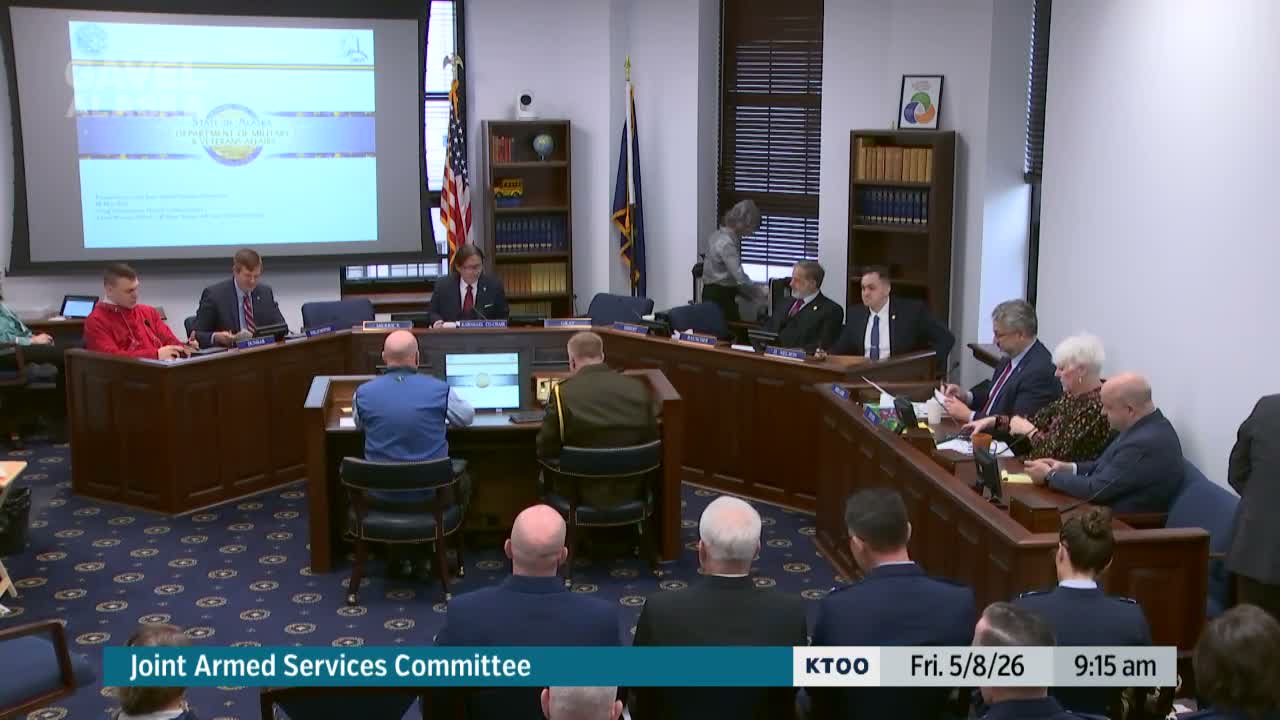
Craig Christensen, deputy commissioner for the Alaska Department of Military and Veterans Affairs, briefed the Joint Armed Services Committee on the department’s structure, community programs and recent disaster responses.
Christensen said the organized militia includes the Air and Army National Guard, the Alaska Naval Militia (about 46 members) and the Alaska State Defense Force (roughly 200 members). He highlighted partnerships with Alaska Aerospace Corporation and the Civil Air Patrol and explained the department’s hub‑and‑spoke approach to reach villages with fixed‑wing and rotary assets.
On Typhoon Halong, Christensen described a large multiagency response: the National Guard, Coast Guard, Department of Public Safety, local search-and-rescue organizations and volunteers supported evacuations. Christensen gave figures for the state response: support to 18 communities, roughly 115,000 pounds of debris removed, about 348,000 pounds of cargo delivered, 491 homes assessed using a mobile app, and around 221 state‑active duty personnel plus 194 active guard/reserve members involved in the response. He said approximately 356 Alaska National Guard members were deployed overseas at the time referenced.
Christensen also summarized the Innovative Readiness Training (IRT) program and urged community organizations to apply for projects that yield both training and community benefit. He described the Guard’s counter‑drug program, funded by proceeds from law enforcement actions, which provides analysts, transportation and aviation support to partner agencies.
Representative Gray asked about an earlier effort to reclassify AGR positions to technician roles (which would affect pay and benefits); Chief Warrant Officer 3 William Tucker replied that the issue had been "turned off" and he was not aware of AGR conversions at this time.
The committee had no formal votes; the briefing concluded and the committee adjourned on time.