Get Full Government Meeting Transcripts, Videos, & Alerts Forever!
Get email alerts on the Board Confirmations topic
No spam. Unsubscribe anytime.
Senate Resources Committee hears confirmation testimony for fisheries, game and assessment boards
Summary
The Alaska Senate Resources Committee on May 8 took testimony from nominees to multiple fisheries and game boards and the State Assessment Review Board, heard public support from industry groups and read a committee report advancing the nominations; no final confirmation votes were taken.
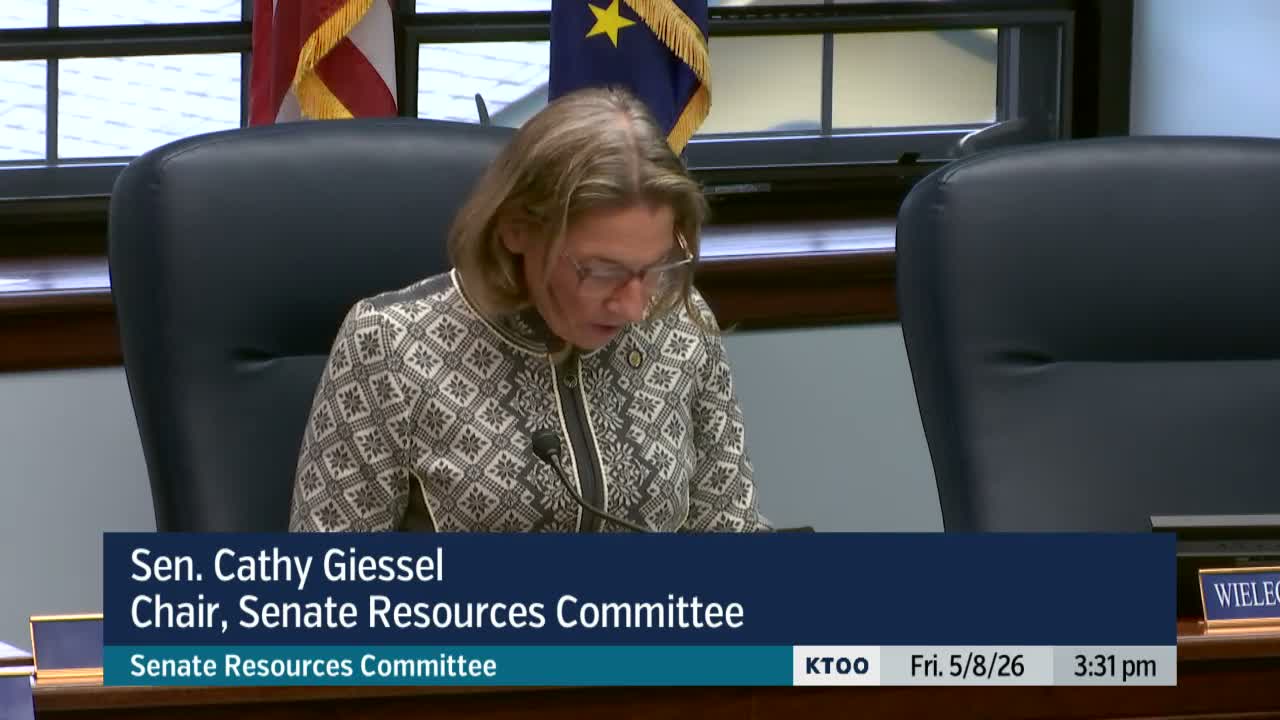
The Alaska Senate Resources Committee convened May 8 to hear confirmation testimony for nominees to multiple boards that oversee fisheries, wildlife and property assessment issues. Chair Senator Giesel opened the meeting at 3:30 p.m., described the hearing order and confirmed a quorum.
Nominees appearing included Tracy Welch for the Alaska Commercial Fisheries Entry Commission (CFEC); Paul Cyr (transcript shows 'Paul Seer'), Blair Hixson and Michael Wood for the Board of Fisheries; Stanley L. Hoffman Jr. and David Loring for the Board of Game; Rudy John Martinez for the Big Game Commercial Services Board; and Jana (transcript name variance: chair said 'Weltzen'; the nominee self‑identified differently) for the State Assessment Review Board. Each nominee gave a brief statement about experience and qualifications and took committee questions.
Tracy Welch, who identified herself as a lifelong Southeast Alaska resident from Petersburg and the executive director of United Fishermen of Alaska (UFA), described three decades of commercial‑fishing experience, tribal leadership roles and work representing fishermen statewide. Committee members asked about Welch’s current employment; she said she is transitioning out of her role at UFA after notification of the nomination and that she is not a member of the Alaska Bar.
Paul Cyr emphasized process, people and science, and when asked about House Bill 93 (a measure discussed in committee that would tie certain resident license qualifications to Permanent Fund Dividend residency rules) he said he had not researched that bill but thought residency requirements merit consideration. On trawl fisheries and bycatch, Cyr said the issues are complex and data‑driven study is needed to guide decision‑making.
Blair Hixson described a background in subsistence and sport fisheries, lodge operations in Western Alaska and regular attendance at Board of Fisheries meetings. Michael Wood, joining remotely, discussed his experience as a set‑netter in Cook Inlet, prior service on a local fish and wildlife commission, and the substantial time commitment that board service requires.
On the Board of Game panel, Stanley L. Hoffman Jr. summarized decades of Alaskan residency, guiding experience and prior board service. David Loring discussed his background as a wildlife biologist and trooper, his prior board service, and voiced conditional support for predator‑control measures when those measures are grounded in scientific research and proper analysis.
Rudy John Martinez, seeking appointment to the Big Game Commercial Services Board, said he is a registered guide outfitter and answered committee questions about a past misdemeanor related to pickup of a roadkill lynx; he said the charge was reduced to a $200 fine after prosecutors confirmed the animal was roadkill.
The nominee for the State Assessment Review Board described a legal practice focused on administrative law, property valuation and quasi‑judicial proceedings and said she would apply neutral, record‑based decision making if confirmed; the committee transcript records a name variance between the chair’s introduction and the nominee’s self‑identification.
Public testimony was largely supportive. Representatives of United Fishermen of Alaska, the Alaska Trollers Association, Petersburg Vessel Owners Association, Resident Hunters of Alaska, Kenai River Professional Guide Association and Kenai River Sport Fishing Association urged confirmation of one or more nominees, emphasizing regional representation (notably Southeast Alaska) and practical fisheries experience. One caller raised concerns about hatchery production and opposed a separate candidate referenced in his remarks.
At the conclusion of testimony the chair read the committee report in accordance with the citation read aloud during the hearing (transcript: "AS 3 9 0 5 0 8 0") and circulated the report for members’ signatures; she reminded members that signing the report does not indicate an intent to vote for or against confirmation in later legislative proceedings. No final confirmations or committee votes were recorded during the May 8 meeting. The committee adjourned at 4:41 p.m. and scheduled its next meeting for May 11 at 3:30 p.m., noting the supporting gas line for Alaskans act will be on the agenda.
Sources: Testimony and public comment recorded at the Senate Resources Committee confirmation hearing, May 8, 2026.