Get Full Government Meeting Transcripts, Videos, & Alerts Forever!
Get email alerts on the School Governance topic
No spam. Unsubscribe anytime.
Portland SD 1J board prioritizes accountability and systems thinking after self-evaluation
Summary
At a March 31, 2026 self-evaluation workshop, the Portland SD 1J Board of Education, guided by OSBA facilitator Dr. Kristen Miles, identified cultural responsiveness, data use and budgeting as strengths and flagged accountability, systems thinking and executive-session confidentiality as priority areas for follow-up.
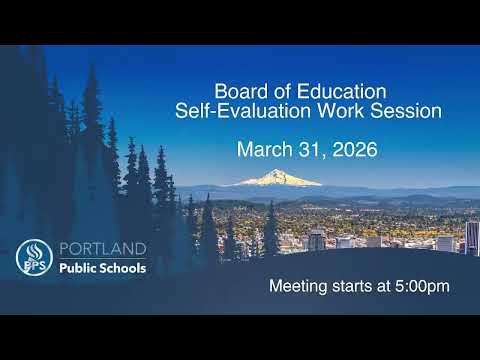
PORTLAND, Ore. — The Portland SD 1J Board of Education held a public self-evaluation workshop on March 31, 2026, in which members reviewed a research-based assessment, identified governance strengths and surfaced priorities for board goals as they begin strategic-planning work.
Dr. Kristen Miles, director of board development at the Oregon School Boards Association, led the session and said the instrument used for the review was developed from decades of research and aligns to 12 standards of balanced governance. "The instrument that we use to evaluate boards is research-based," Miles told the board, describing the tool's provenance and how it links assessment to follow-up goals.
Why it matters: Board self-evaluation is intended to sharpen governance by clarifying how directors work together, how the board oversees the superintendent and district priorities, and which practices should be institutionalized. The board agreed to use results to shape a monitoring plan and to pair goal-setting with the district's upcoming strategic-planning and community-engagement efforts.
Key findings and priorities The facilitator summarized the board's highest self-rated areas as cultural responsiveness, use of multiple kinds of data for continuous improvement, and budgeting and financial oversight. By contrast, the data pointed to top areas for improvement: accountability (monitoring progress toward strategic goals), becoming a learning organization (ongoing professional development and reflection), and systems thinking (assessing district-wide impacts before shifting resources).
Board members discussed specific items with wide score ranges. The facilitator flagged several questions where members’ ratings diverged, including how the board collaborates with the superintendent on long-range strategic goals, the board's role in advocating for public policy that supports education, the preservation of executive-session confidentiality, and whether the board consistently reviews monthly financial statements.
Process and next steps Members and the facilitator discussed practical follow-through: setting one or a few board performance goals, building a monitoring calendar that schedules quarterly reviews of high-investment initiatives (for example, new curriculum rollouts, high-impact tutoring, or summer programs), and aligning monitoring work with the district's strategic-planning calendar and the "Growing Great Schools" community engagement effort.
Several directors noted that tenure and timing matter: newer board members said they have not seen a full strategic cycle and may rate items differently than longer-serving members. The group discussed using the assessment results to inform onboarding and targeted professional development so new members can better understand past work and current priorities.
Concerns and candid exchanges Some members expressed concern about the spread of responses on questions about executive-session confidentiality, calling for follow-up because of potential legal implications. Members also discussed the difficulty of monitoring student outcomes while the district continues to contend with significant budget cuts; one participant recalled that early years of recent work required cutting more than $100 million, a factor members said must be considered when interpreting outcome trends.
Student voice and community engagement Board members recommended including student input as an early indicator when evaluating new programs and curricula, for example with short surveys soon after students receive new materials. The board plans to pair its monitoring plan with broader community engagement this summer and fall so goals reflect district priorities and community values.
The board ended the session by agreeing to continue the conversation in a retreat or subsequent work session and to bring draft goals and a monitoring calendar back for action as the strategic-planning cycle moves forward. The meeting was streamed live to the PPS YouTube channel and adjourned that evening.