Get Full Government Meeting Transcripts, Videos, & Alerts Forever!
Get email alerts on the Transportation Technology topic
No spam. Unsubscribe anytime.
T DOT official previews 3D design rollout, pilot project and contractor outreach
Summary
Jennifer Lloyd, T DOT design director, told the Tennessee Board of Architectural and Engineering Examiners the department is migrating from 2D Bentley tools to 3D Open Roads Designer, launching a 10‑year roadmap, ProjectWise migration and a pilot project on SR‑52 to test contractor handoffs and utility conflict checks.
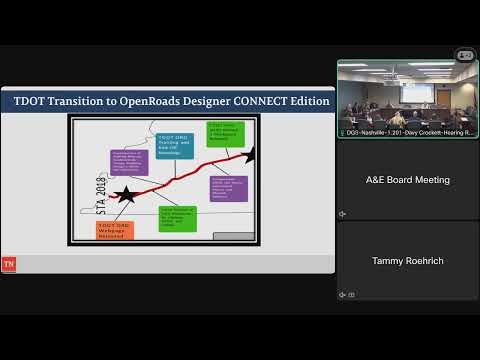
Jennifer Lloyd, identified as T DOT’s design director and head of technical training and production support, told the board on April 2 that Tennessee is moving toward 3D design as the standard for producing plan sets and coordinating utilities and grading. “We’ve always used a Bentley product…we had been using a 2D product. So we really didn’t have that ability to go in and look at those graphics,” Lloyd said, describing the department’s shift to Open Roads Designer and the benefits of three‑dimensional modeling.
Lloyd walked members through a multi‑pronged rollout: training modules for internal and external users, a ProjectWise migration so staff and consultants can find shared project files, and a 10‑year road map that prioritizes data standards, tools, policies and workforce skills. She said the change aims to reduce construction delays caused by unexpected utility conflicts by enabling earlier detection in the model: “When you have this 3D software…you can do a utility confliction and it will let you know immediately you got a problem here,” she said, while acknowledging that the approach depends on the quality and timeliness of utility data.
The presentation focused on contractor outreach and the department’s pilot on State Route 52 (Portland area). Lloyd described contract language used in the pilot to ensure post‑award coordination, an intent to run ‘‘boots‑on‑the‑ground’’ field reviews with contractors after award, and a plan to offer workshops and region‑level demonstrations for contractors who do not use Bentley tools. She said T DOT’s consultants (named in the presentation) have been reviewing new survey packages and helping with early pilots; ProjectWise will host model artifacts and make them accessible to internal and external stakeholders.
Board members asked whether a 3D model might replace the sealed PDF plan set as the official engineering record. Lloyd said some states are doing it but Tennessee will wait until contractors and T DOT are confident the pipeline is reliable, the models consistently match sealed plan content and the stakeholders are comfortable with sealing workflows used elsewhere. She described discussions with other DOTs and federal groups to align standards and said further evolution (including possible legislative or procedural steps) will be considered as projects and pilots mature.
Next steps Lloyd outlined include additional region‑level workshops, targeted surveys to improve subsurface utility data earlier in projects, continued workspaces and manuals updates as Bentley and Open Roads evolve, and expanded pilot projects across regions so both consultant‑designed and in‑house projects can test the workflow.
Lloyd’s presentation concluded with the board’s recognition of the operational and training work required to bring more projects online in 3D; she estimated several years before a wide majority of projects are delivered as 3D models and urged incremental adoption and continued outreach to utilities and contractors.