Get Full Government Meeting Transcripts, Videos, & Alerts Forever!
Get email alerts on the Comprehensive Plan topic
No spam. Unsubscribe anytime.
Sedro-Woolley council, planning commission set April 22 public hearing on updated comprehensive plan
Summary
City staff and consultants reviewed Version 12 of Sedro-Woolley's comprehensive plan, noting agency-driven edits to housing, transportation, parks, capital facilities and a new climate chapter; council set a public hearing and second reading for April 22 and sent the plan to a closed executive session on real estate.
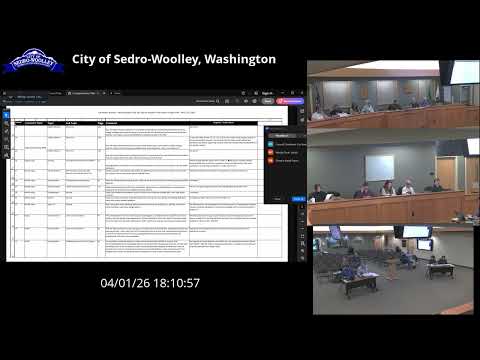
Sedro-Woolley officials reviewed Version 12 of the city's comprehensive plan and set a council public hearing and second reading for April 22, the council decided at a joint meeting of the city council and planning commission.
Tom Glover, the city's director, told the council the draft incorporates comments from the required 60-day review and later submissions. "We are presenting you with version 12 of the comp plan," he said, adding that staff had marked edits in red to show substantive policy changes and that the city's attorney advised a second public hearing at council.
Why it matters: completion of the comprehensive plan affects the city's eligibility for some state funding and guides land use, transportation and capital-investment priorities. Glover warned that if applications for state funding are submitted while the plan remains incomplete, grant reviewers could question eligibility.
Consultants and agency comments
Matt Covert, senior planner with Facet, briefed the council on responses to agency and public comments, saying the consultant team "responded to every comment and addressed, you know, updated the document where appropriate." Agencies that provided substantive feedback included the Washington Department of Fish and Wildlife, the Department of Natural Resources, the Department of Commerce and regional utilities; topics ranged from stormwater and habitat to transportation modeling.
On stormwater, staff said they added a cross-reference to the stormwater management action plan and specifically noted Brickyard Creek work requested by Fish and Wildlife. On vegetation standards, staff declined to adopt prescriptive regulatory language in the comp plan, noting the plan instead sets the policy framework that could enable future development regulations.
Housing and implementation
Staff and consultants described revisions to the housing element to align with Department of Commerce guidance and recent administrative case law. The update compares the capacity in the adopted plan with the proposed plan across area median income brackets and identifies remaining affordability gaps. As Covert explained, the plan lists implementation tools the city could pursue — such as density incentives, ground leases or code changes — but does not commit the city to building affordable units directly.
Councilmembers pressed staff to distinguish clearly between actions the city can implement itself and outcomes that depend on outside funding or market forces. "I do not want the document to read as if the city has promised outcomes that it does not directly control," Councilman D. Young said. Staff noted the city will need to track permits and housing outcomes through the state-mandated progress reporting timeframes.
Transportation: active-transportation and modeling
Public works staff discussed transportation-element changes required by regional reviewers and the insertion of active-transportation considerations into concurrency management. The city's public works director, Bill, described the approach: keep vehicle peak-hour congestion modeling as the baseline while adding performance measures for pedestrian and bicycle connectivity so new development fills sidewalk and bicycle network gaps where feasible. "Now, they call it active transportation. It's just the newest buzzword," he said, discussing the change in state terminology.
Bill also said staff will correct map/model mismatches caused by an early model run and noted two intersections — SR 20/Reed Street and Cook Road/Trail Road — remain priorities on the six-year Transportation Improvement Program.
Parks, capital facilities and utilities
The parks chapter received edits to reflect historical features and possible long-range ideas such as a railroad-park concept through the central business district and trail connections tying the Swift Center to Riverfront Park and Brickyard Creek. Council members asked staff to remove or clarify outdated references (for example, a pedestrian overpass on State Route 20) and to tie proposals to feasible phasing.
The capital facilities chapter consolidates the city's inventory of buildings and projects and highlights a wastewater treatment plant upgrade for which the feasibility (facility) plan is nearing completion; staff said construction is targeted in the 2028 horizon. The public utilities element summarizes franchise utilities (Scadget PUB, PSE, Cascade Natural Gas, major telecom providers) and notes that regional capacity investments made in prior planning cycles shape local options.
Climate element and cross-cutting questions
The plan includes a new climate element required by the state that addresses greenhouse-gas reduction, resilience — notably flooding and wildfire risk — and possible implementation steps such as a cost analysis for converting city fleets to zero-emission vehicles. Council members sought clarity on which actions are immediate, measurable commitments and which are studies or exploratory items.
Formal actions
Councilman Henderson moved and Councilman Ko seconded a motion to set a council public hearing and a second reading on the comprehensive plan for April 22. The council approved the motion by voice vote; the transcript does not include a roll-call tally.
Later in the meeting, the council approved a motion to hold an executive session that night to discuss real-estate matters under state law; the public meeting record shows the session was held and that the council returned without taking public action.
What's next
Staff said they will issue the next draft (anticipated as Version 13) incorporating the edits discussed and distribute the comment matrix to councilmembers before the next meeting. The council directed staff to provide a redline version and the matrix ahead of the April 22 public hearing so members and the public can review the latest changes.
Attribution: quotes and attributions in this story come from the official meeting transcript and are attributed to speakers who identified themselves in the record (Tom Glover, Matt Covert, Bill, Councilman D. Young and others). The transcript consistently shows the place name spelled as "Cedar Woolly"; this article uses the locally recognized and normalized spelling "Sedro-Woolley."