Get Full Government Meeting Transcripts, Videos, & Alerts Forever!
Get email alerts on the Jefferson Modernization topic
No spam. Unsubscribe anytime.
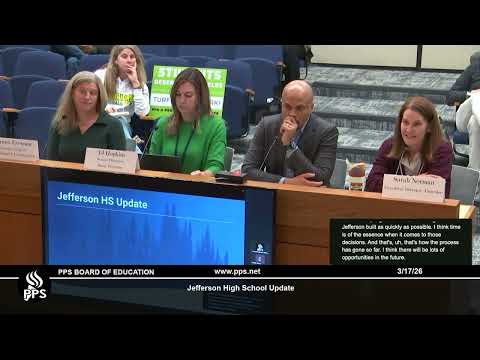
Presidio study finds Jefferson "shell" option yields only modest time savings; district stays on original schedule
Summary
Presidio's feasibility study for a Jefferson High School "shell" accelerated-occupancy option found at best 2'3 months of targeted schedule savings and a potential net project cost increase (~$600,000). PPS leadership and RISE recommended remaining on the current schedule with a projected August 2029 move-in.
Presidio and the RISE team told the Portland Public Schools Facilities Improvement and Oversight Committee on March 17 that a feasibility study of a "shell" option for Jefferson High School produced only limited schedule benefits and carried potential net cost increases, leading district leadership to keep the project on its current timeline.
The study, presented by Sarah Norman, executive director of RISE at Presidio, and contractors from Kas Hoffman, concluded the shell approach could shorten some general-condition and related durations by about 2 to 3 months but would create operational tradeoffs for early occupancy, including increased noise, dust, temporary instructional spaces and site-safety risks. "When we went through that analysis, we determined that the shell option wasn't going to be the right move," said Stephanie Coyle, project executive for Hoffman Construction.
Why it matters: Jefferson is one of three high schools the district is delivering under the 2025 bond. Any change that accelerates move-in could shift sequencing and cost exposures across the program. The Presidio analysis quantified those trade-offs: Presidio's original contract deliverable that included this feasibility work was $149,500, the presenters said, and the exercise identified roughly $47,748 in general-conditions savings but a projected potential net budget increase of about $600,000 when accounting for labor inefficiencies and other expedited-schedule costs.
Board members pressed the team on whether the shell option had been a foregone conclusion and on timing and cost transparency. Norman said the team conducted objective workshops from December through February and that no additional district cost was incurred for the feasibility analysis. "No option is ever a foregone conclusion until you put pen to paper and do the work to understand what is required to make that happen," she said.
Operational impact and schedule: The study found temporary accommodations could allow occupancy of first-and-second-floor spaces for a 2028–29 school year but that the realized early-occupancy window was modest in practice. Based on the team's review, RISE and district leadership recommended staying with the existing schedule; presenters identified an anticipated move-in date of August 2029 and said South Fields construction would begin in summer 2026.
Contracting and oversight: Board members asked how the feasibility work related to the Presidio contract and whether the study returned value for voters. Presenters said the feasibility work was included in the Presidio deliverable and that the study produced both schedule efficiencies and actionable process improvements (for example, better use of digital reporting tools such as Procore). "These are little small details that people normally don't think of, but when you're having an atmosphere when people are able to think outside the box, we have really good teams and we empower our teams to come up with ideas," Andrew Collis, identified by Presidio as a Kas Hoffman lead, told the committee.
What comes next: The committee did not take any formal action; staff will continue to execute the approved schedule and report back on milestones such as permitting and construction starts. The Presidio team recommended continued focus on safety and schedule efficiencies rather than pursuing the shell option as the program moves into the modernization and construction phases.