Get Full Government Meeting Transcripts, Videos, & Alerts Forever!
Get email alerts on the Business Development District topic
No spam. Unsubscribe anytime.
Council moves proposed Macomb Business Development District to second reading after public questions about governance and competition
Summary
The council discussed a proposed Macomb Business Development District that would impose retailer, service and hotel-operator occupation taxes; residents asked how the district would be governed and whether an affiliated organization could compete with local businesses. The ordinance was placed for second reading; no final vote was taken.
Macomb — The Macomb City Council Committee of the Whole discussed an ordinance to designate the Macomb Business Development District No. 1 and to impose retailer, service and hotel-operator occupation taxes in the proposed district.
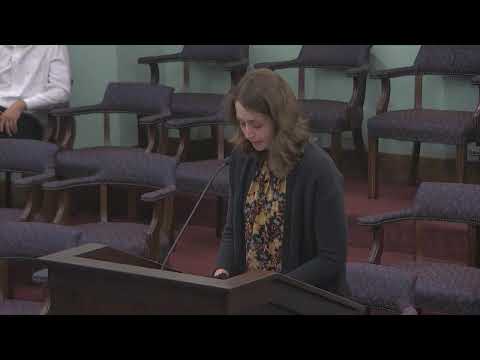
The item returned to the council after a first reading. At the meeting a resident, Kenan Albbright, urged the council to treat the area around the university and downtown as an economic zone that improves pedestrian safety and better serves students, saying the district could help attract and retain students. “You can’t walk safely, conveniently or easily to get a slice of pizza,” Albbright said, arguing that walkability and nearby amenities matter to student life. He asked who would run the organization, how decisions would be made, whether it would have enforcement power, how fairness would be ensured and whether the organization might create commercial ventures that compete with businesses inside the zone.
Council members did not take a final vote on the ordinance at the meeting. City staff noted the proposal had been presented previously by the city’s consultant, Mr. Steve Klein, and the council placed the ordinance on for a second reading and final action at the next meeting. No final tax rates, district boundaries or implementing board structure were adopted at the meeting.
Why it matters: A business development district that levies occupation taxes and is governed by a separate entity can shift how downtown projects, marketing and infrastructure are financed and managed. Albbright’s public questions about governance, enforcement and potential competition are the kinds of policy and ethical issues the council will need to clarify before final approval.
What’s next: The council scheduled the ordinance for a second reading and final action at its next meeting; staff and consultants are expected to provide more detail on district boundaries, proposed tax rates and the governance model before that vote.