Get Full Government Meeting Transcripts, Videos, & Alerts Forever!
Get email alerts on the School Libraries topic
No spam. Unsubscribe anytime.
Community speakers urge Long Beach Unified to reconsider library staffing cuts
Summary
Parents, librarians and educators told the Long Beach Unified Board that proposed reductions to librarian and media assistant positions would undermine equitable access to libraries, citing specific proposed cuts and research linking libraries to student achievement.
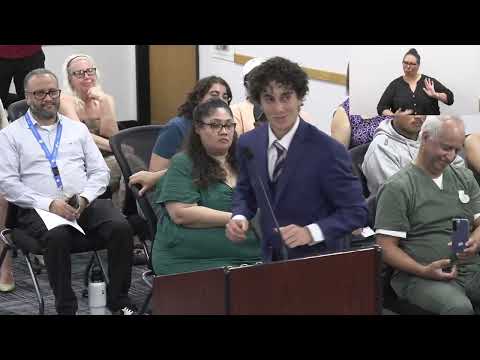
Public commenters packed the board meeting to plead with the Long Beach Unified School District to reverse proposed cuts to school libraries and student-facing staff.
Karin Wasinger, a teacher librarian at Poly High School, said her site sees "over 450 daily student visits, often surpassing 500," and warned that the district’s proposal would eliminate the full-time media assistant who helps sustain that demand. "I really don't know how I will continue to maintain our collection to meet our student needs and interests," she told the board.
Several speakers linked the staffing proposals to broader district priorities. Jamie Vallianos, a 27-year LBUSD educator, said central office positions have grown since 2020 while enrollment has declined and urged the board to reflect its stated student-centered goals in budget choices. "If enrollment is declining, why are we still structurally larger at central offices than before COVID?" he asked, and noted the district plan would reduce librarian positions from 37 to about 20 and media assistants from 20 to five.
Members of the public also cited research and state guidance. Ashley Nichols-Lampkin, a media assistant and parent, told the board that the California Department of Education recommends school libraries be open at least 36 hours per week and said proposed staffing would leave some libraries open as little as eight hours a week. "When libraries are well-staffed, students do better," she said.
Union representation raised fiscal questions. Dallas Emerle of the California School Employees Association Chapter 2 disputed the narrative that there was no alternative, saying the district’s reported excess deficiency improved from $176 million to $77 million before cuts and that some budget line items had shifted across reports. "If you are being told based on this information that you need to cut your libraries, you're being misled," he said.
Speakers repeatedly framed the cuts as choices that reflect priorities. Kat Tacea, who has worked in Title I schools for 27 years, said closing a school's library half the time "is not an equity decision" and urged the board to eliminate or reduce administrative layers instead of student-facing services.
Board members heard the testimony but did not take a final vote on library staffing during the meeting. Several board members acknowledged the public comments and asked staff for more detailed scenarios and clarity on which central-office positions are funded from restricted sources and which are supported by general funds.
The public testimony added to a string of budget-focused remarks across the evening, and board members said they will continue this conversation at the April updates and through the fiscal stabilization planning process.