Get Full Government Meeting Transcripts, Videos, & Alerts Forever!
Get email alerts on the Weed Control topic
No spam. Unsubscribe anytime.
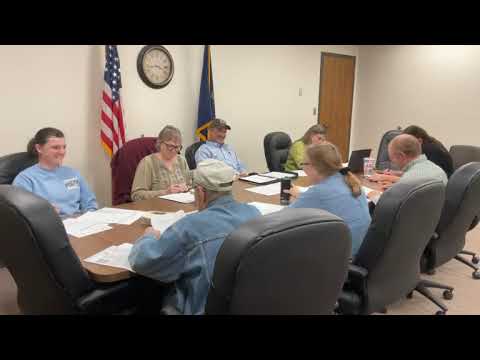
Oliver County Weed Board appoints new weed control officer and approves 2025 cost-share pricing and pickup plan
Summary
The Oliver County Weed Board voted to appoint a new weed control officer and approved an updated 2025 retail price list and a two-day primary pickup policy for cost-share herbicide distribution; vendor Nutrient Egg provided the pricing and one product saw a large price spike.
The Oliver County Weed Board voted to appoint a new weed control officer and approved an updated 2025 retail price list and pickup plan for the county’s cost-share herbicide program at its meeting.
Alice Gstein, Oliver County’s HR director, led a structured interview of the unnamed candidate, who described long experience as a commercial applicator and running a spray business across multiple states. “It’s a job that needs done,” the candidate said, citing past work identifying and treating noxious weeds and holding a commercial applicator’s license since the early 2000s. He described one past application mistake and said the remedy was watering and re-sodding affected lawns.
The board discussed the position’s scope and compensation. Members referenced a $28 hourly rate and agreed to cap county payments for the role at $3,500 for the year; the candidate said he could begin immediately. The board also emphasized that distribution or delivery of restricted-use pesticides must be done off county payroll if handled on the contractor’s personal time and that county credential checks and signatures are required at pickup for restricted products.
On procurement and pricing, staff reported that Nutrient Egg (Spearfish) returned pricing after other bidders did not respond. The board compared those prices to the North Dakota Weed Control Association listing and past order records. Members noted prior large orders (transcript references include past individual orders of roughly $57,000 and $74,000 in earlier years and smaller reorders) and discussed availability risks if particular chemicals become scarce.
A notable pricing change was for a product referenced in the transcript as Venue (also discussed under Pinnacle): its per-quart vendor price rose from roughly $100 in earlier lists to about $300 in the current vendor quote. Board members proposed and agreed to set the retail price for that product substantially above a strict 20% markup to avoid underpricing—transcript discussion settled on an $80 retail figure for that item (rounded above a 20% surcharge on the quoted cost).
After reviewing line-item calculations and rounding conventions (board members favored $5–$10 increments to simplify billing), a member moved to approve the adjusted 2025 retail price list with the changes discussed; another member seconded the motion. The motion carried by voice vote; the transcript records the motion, second and “all in favor” but does not include a roll-call tally. Kindle moved the pricing motion and Byron seconded, as noted in the transcript.
The board agreed to a primary two-day pickup window for pre-ordered chemical distribution and said it would strongly encourage landowners to pick up during those days; staff will provide a reorder option with a deadline of June 30. The board also discussed temporary county storage options for pesticides, including a labeled shipping container with a wash station and required eyewash/shower facilities, and assigned follow-up to check legal labeling and storage compliance.
Other meeting items: members discussed the condition and potential sale of unused sprayers and equipment, the need to maintain accurate mailing lists and eligibility checks (the cost-share program is limited to Oliver County landowners), and a Department of Agriculture survey about county noxious-weed acreage and board membership that Dorothy will follow up on.
The meeting concluded after the board agreed next steps on the letter, pickup scheduling, and follow-up tasks.
Ending: The board approved the candidate’s appointment and the adjusted pricing and pickup plan; several members were assigned to finalize the cost-share letter and follow up on storage, legal compliance and the Department of Agriculture survey.