Get Full Government Meeting Transcripts, Videos, & Alerts Forever!
Get email alerts on the Public Records topic
No spam. Unsubscribe anytime.
Cochise County attorney outlines public‑records process, possible fees for voluminous requests
Summary
County civil counsel reviewed who controls records, the five factors that determine promptness, and discussed potential per‑document fees and body‑camera charges; staff will return with a proposed fee resolution at a future work session.
The Cochise County Board of Supervisors on March 24 heard a legal briefing on public‑records requests from county civil counsel, who outlined which offices hold records, how request promptness is judged and how the county may respond to voluminous requests.
Mr. Whitehead, introduced by the chair to review the legal aspects of records requests, said three distinct custodians exist in Cochise County: the clerk of the superior court (court records), the sheriff’s office (law‑enforcement and jail records) and the county civil attorney’s office (the remainder). He said requests landing with the wrong office are referred to the appropriate custodian and that the county cannot centrally oversee or access records held by separately governed local districts or municipal offices.
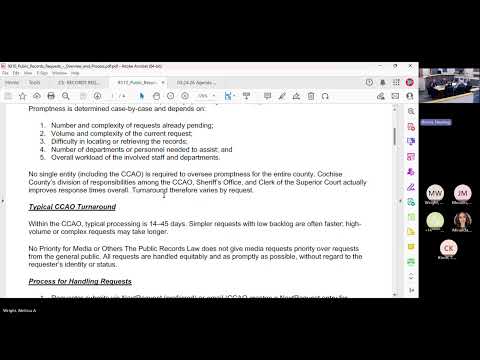
Whitehead said the statute cited in the presentation (listed in materials as ARS 39121.01E 01E) requires an initial reply within five days but that substantive fulfillment is not precisely defined by case law. “It comes down to these five factors” he said, listing the number and complexity of pending requests, complexity of the current request, difficulty in locating or retrieving records, the number of departments or personnel needed and the overall workload of involved staff.
Board members asked about costs. A supervisor observed that sheriff’s offices may charge for body‑camera footage; Whitehead said a statute now allows law‑enforcement agencies to set a rate for body‑camera video and that the county could, within statutory limits, adopt narrowly tailored charges for non‑commercial, time‑intensive requests. He described an approach based on time spent (for example, a paralegal’s hourly time) and discussed a per‑document pricing model that staff plan to propose. Whitehead said a prior board resolution to charge across sheriff, clerk and civil offices had been rejected, but that there appears to be renewed interest in narrowly tailored fees to discourage overly broad requests.
Whitehead described typical civil‑attorney office turnaround for complex requests as roughly 14 to 45 days, noting some simple items can be fulfilled in a day while more complex matters take longer. He also described operational improvements after new software was implemented in October 2024 that reduced the backlog from nearly 100 to below 50 outstanding requests.
On publication practices, staff said they are marking commonly requested items as candidates for automatic posting to the public website (a ‘publish’ vs. ‘do not publish’ designation) so fulfilled requests become searchable and reduce repeat demand. Taylor in the attorney’s office was named as the staff member responsible for posting fulfilled records via NextRequest.
Next steps: staff will return in a future work session with a proposed fee resolution and a detailed pricing approach for board consideration; there was no vote at this meeting.