Get Full Government Meeting Transcripts, Videos, & Alerts Forever!
Get email alerts on the Housing Land Use topic
No spam. Unsubscribe anytime.
Housing and land‑use package survives near‑failure; state SHIP fund and MIHP changes included
Summary
ULCT staff said the major housing-and-land-use package was at risk late in session but passed after consolidation. Key outcomes: a state housing infrastructure partnership (HB492) with ~$100M for local system infrastructure, MIHP reorganization/freeze for 2026, and new ADU/land‑use application changes carried in SB284/HB492/HB68.
Speakers told LPC members the housing and land‑use package nearly failed during the final days of the session but ultimately passed after substantial negotiation and consolidation of multiple bills into larger vehicles.
Jared, speaking for the housing team, described House Bill 492 as creating a State Housing Infrastructure Partnership (SHIP) and dedicating roughly $100 million to a revolving loan fund to help local governments finance system infrastructure needed to unlock planned housing units. "What House Bill 492 does is it really kind of becomes the partnership that we've been asking for in this...and it dedicates $100 million...to a revolving loan fund to help local governments with system infrastructure improvements to support new growth," he said.
Staff said HB492 also includes up to $140 million in bonding grants from a highways‑of‑the‑first‑class county fund and additional provisions related to Point of the Mountain. Separate reorganizational legislation, HB68, consolidates state housing programs under a single agency effective July 1 and will move programs such as MIHP under that agency.
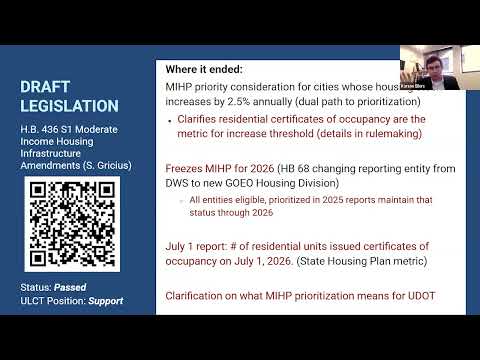
ULCT described HB436 as a newly added path for cities with sustained high growth to access MIHP prioritization and said the state will freeze MIHP for calendar year 2026 while the new agency is stood up and MIHP 2.0 is implemented. Cities prioritized in 2025 retain their status through 2026; one required reporting item remains a count of residential certificates of occupancy due July 1.
The meeting also reviewed annexation and land‑use bills: HB457 (automatic annexation of qualifying inner islands in certain counties) was narrowed and passed; other proposals (including a preferred land‑use pathway HP184) were held or failed. Staff emphasized that many land‑use changes were folded into SB284 and urged members to attend forthcoming webinars for implementation guidance.
Next steps for local governments include reviewing how SHIP applications will be administered, monitoring rulemaking tied to the new housing agency, and preparing to submit any MIHP‑related reports with the July 1 deadline.