Get Full Government Meeting Transcripts, Videos, & Alerts Forever!
Get email alerts on the Session Overview topic
No spam. Unsubscribe anytime.
ULCT week-8 wrap-up: record bill drafting, fewer passes as big omnibus measures folded in
Summary
The Utah League of Cities and Towns Legislative Policy Committee summarized outcomes from the recent session: an unprecedented number of bills were drafted (~1,160), about 540 passed, and many substantive provisions were consolidated into a few large omnibus bills affecting housing, economic development, taxes and water planning.
Justin Lee, deputy director at the Utah League of Cities and Towns, opened the week‑8 wrap‑up by saying the goal was to give a concise final disposition of the bills discussed during LPCs this year. "My name is Justin Lee. I'm the deputy director here at the league," he said, and urged members that the session review would be high‑level rather than deeply technical.
Staff reported the legislature drafted roughly 1,160 bills this year, a record, while only about 540 bills passed — one of the lower totals in recent years. The staff emphasized that many substantive proposals were folded into a handful of "monster" omnibus measures, which concentrated policy changes into larger bills rather than numerous smaller enactments.
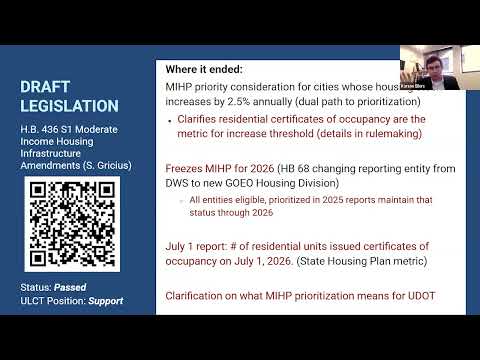
The wrap‑up highlighted several crosscutting themes: housing and land use reforms were consolidated into major packages, significant changes and clarifications to truth‑and‑taxation and property‑tax procedures were adopted in HB236, and economic‑development reporting and tax‑increment rules were centralized under the SB206/HB507 framework. Water‑related proposals generated extensive discussion but most failed or were rolled into other measures; select language from a water planning bill (HB439) moved into SB284.
Speakers urged members to watch for interim work: legislative audits (notably on impact fees), new reporting and implementation rules for tax‑increment and redevelopment tools, and multiple webinars from ULCT offering deeper technical guidance in coming weeks. Lee said the staff will distribute the slide deck and recording and host targeted trainings on property taxes, economic development, and land use.
The meeting closed with reminders about upcoming events, including the ULCT midyear conference in St. George (April 22–24) and further LPC sessions likely in May or June.
The wrap‑up served as a procedural and strategic briefing for municipal leaders and staff rather than a policy forum for new positions; it emphasized next steps for implementation and training rather than new advocacy steps.