Get Full Government Meeting Transcripts, Videos, & Alerts Forever!
Get email alerts on the Land Use topic
No spam. Unsubscribe anytime.
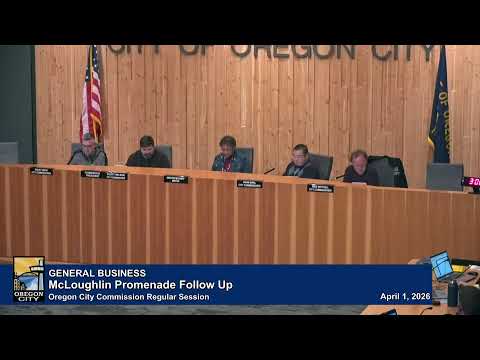
Oregon City approves Promenade ballards and parking plan, revises shoreline‑access letters
Summary
The commission approved a Promenade ballard configuration and parking 'Option C', asked staff to adjust acknowledgement letters so primary‑access stairs may be rebuilt in place, and authorized staff to pursue a concept for an emergency truck detour/right‑of‑way near Tumbwater Drive for future ODOT coordination.
The Oregon City Commission voted April 1 to install removable ballards on Promenade and South Bluff streets, adopt a staff‑preferred parking configuration (Option C), and direct staff to update remaining acknowledgement letters so that primary‑access stairs or landings serving residences may be rebuilt to a substantially similar footprint.
Assistant City Manager Troutman presented draft acknowledgement letters and three parking options for the McLofflin Promenade project. The staff packet noted that closing Promenade could affect parking and garbage pickup patterns and that some parcels may need driveway adjustments. The ballard plan on the preferred map would restrict vehicle access to most of the Promenade while preserving controlled access points for emergency or service use.
Several property owners raised a specific wording concern about draft letters that said structures "if destroyed" could not be rebuilt. Jim (302 Bluff Street) told the commission he had reviewed prior meetings and objected to the stronger "destroyed" prohibition. Commissioners agreed on a consistent compromise: stairs and landings that provide primary access to a residence may be repaired or rebuilt to a substantially similar footprint; purely discretionary decks that are not primary access would be treated more restrictively.
On parking, the commission adopted Option C, the work‑session preferred layout, which staff said best balances on‑street parking with park access and operational needs. Staff noted one privately used parcel adjacent to Promenade would lose up to two informal parking spaces under the ballard plan; that owner may pursue driveway changes or other access arrangements if desired.
The commission also gave conceptual approval to study dedicating a small right‑of‑way near Tumbwater Drive to provide an engineered emergency truck detour/turnaround route for very large vehicles during closures of 99E, and asked staff to coordinate with ODOT on feasibility and design. Staff said any change would require engineering to meet turning‑radius needs and an agreement on removable ballards and signage for emergency use.
Votes and next steps: the commission approved the ballard configuration and parking option by roll call and asked staff to resend or reissue the small set of revised acknowledgement letters for the properties still under consideration to reflect the rebuilt‑primary‑access language; staff will continue coordination with ODOT on the Tumbwater emergency‑route concept.