Get Full Government Meeting Transcripts, Videos, & Alerts Forever!
Get email alerts on the Transportation topic
No spam. Unsubscribe anytime.
ODOT seeks multi‑year time extension for Abernathy Bridge work; Oregon City wins commitment to negotiate business‑focused IGA
Summary
ODOT told the Oregon City Commission that completing the Abernathy Bridge seismic retrofit will extend into 2027–28 and asked to keep temporary work areas in place; the commission unanimously directed staff to negotiate an intergovernmental agreement setting signage, business‑access and other deliverables before any further extension is approved.
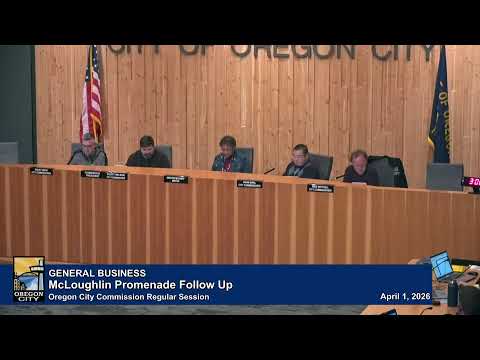
The Oregon City Commission on April 1 heard a detailed presentation from the Oregon Department of Transportation on delays and remaining work for the Abernathy Bridge widening and seismic retrofit, and unanimously directed staff to negotiate an intergovernmental agreement (IGA) that would set local deliverables for signage, business access and other mitigations.
ODOT Region 1 manager Ryan Winshimer told the commission the bridge contractor is ‘‘making progress’’ but that schedule changes and unexpected structural work extended the project. ODOT project managers said major bridge work and large equipment are expected through spring–fall 2027, the agency anticipates barges and cranes removed by the end of 2026, soil‑stabilization work will occur in 2027–28 and final landscaping and a plant‑establishment period would follow in 2028.
Why it matters: businesses along the river told the commission the staging and appearance of the work have driven customers away and caused steep revenue declines. Several business owners urged stronger, enforceable commitments from ODOT — particularly signage that directs customers to open businesses, clearer on‑site delineation of public versus construction areas, and targeted business support — before the city grants additional extended use of parkland and right‑of‑way.
"We were missing two... but we had quite a lively discussion," William Gford, an Oregon City resident and business‑alliance director, told the commission earlier in public comment; later Sportcraft tenant Sam Dvo described a ‘‘decrease in visitation and revenue in a dramatic way.’’ Gordon Lawrence, a long‑time boat owner and contractor, said: "If I ran a project the way that this has been going, I would be out of business." Those remarks underscored repeated requests from commissioners for concrete, time‑bound commitments.
ODOT acknowledged shortcomings in public communications and local business outreach. Winshimer said the agency "regret[s] we did not explain more about what we were asking for" at earlier briefings and said staff had begun steps to increase visibility of businesses in the project area, add business‑access signs and link a list of open businesses from ODOT project webpages to the Oregon City Business Alliance and the chamber.
ODOT also told the commission how federal funding limits compensation. Vidal Francis, an ODOT area manager, said federal rules allow compensation for real property impacts but do not permit payments for lost business revenue. He noted past compensation by ODOT under earlier right‑of‑way agreements totaled more than $900,000 to two property owners and that ODOT expected roughly $300,000 in additional temporary‑use compensations tied to the current extension.
Commissioners and residents pressed ODOT on several points: why signage and on‑site delineation were not implemented earlier, whether park areas marked as open were actually accessible, and how the agency would hold the contractor accountable. ODOT said it has mechanisms to withhold payments and pursue liquidated damages (it cited contract provisions and said liquidated damages could apply), and that the agency had provided the contractor additional tools and directed efforts to accelerate schedule recovery.
After the public comment period, Commissioner Wilson moved that city staff begin negotiations with ODOT to produce an IGA with specific, enforceable deliverables — including signage and public‑access commitments for the business area, work‑area delineation, and a two‑phase extension approach tied to milestones — and to explore how the city can secure expedited attention to other local projects such as the downtown quiet zone. The motion was seconded and passed unanimously on roll call.
What the commission did not do: it did not approve a formal extension of the lease or work‑area agreement at the meeting. Instead, the commission asked staff to negotiate enforceable language and milestones with ODOT, and to return with an agreement the commission could approve or reject.
Next steps: staff will begin negotiations with ODOT on an IGA spelling out the city’s expectations for signage, access, business outreach, and milestone‑based time frames. The commission indicated it would consider a time‑phased approach that separates major in‑water equipment removal from subsequent, smaller‑footprint soil stabilization and landscaping work so the most disruptive elements leave the site sooner.