Get Full Government Meeting Transcripts, Videos, & Alerts Forever!
Get email alerts on the Education topic
No spam. Unsubscribe anytime.
Mayor's Office of Education touts PreK expansion and youth-job targets as council raises equity concerns about school closures
Summary
Dr. Deborah Carrera outlined MOE priorities including expanding PHL PreK by 100 seats, extended-day and year programming, and a student loan help center; council members pressed the office and district on a proposed school facilities plan they say disproportionately affects Black and Latino students.
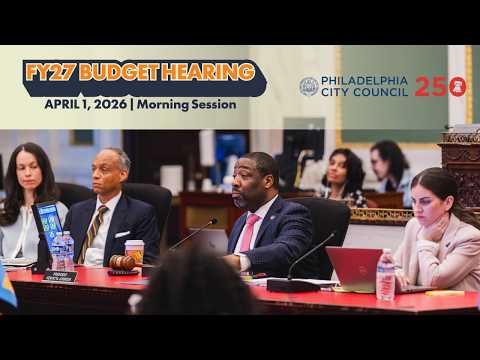
Dr. Deborah Carrera, chief education officer, told the Committee of the Whole that the Mayor's Office of Education will use the FY27 budget to expand early learning, extend after-school and year-round opportunities, and align education programming with workforce pathways.
"My name is Dr. Deborah Carrera, the chief education officer for the city of Philadelphia," she said, describing the mayor's education priorities and the office's role convening city departments and educational stakeholders.
Pre-K expansion and quality supports: Carrera and early-childhood staff said DHS and the Office of Children & Families administer PHL PreK in coordination with MOE. Officials said the FY27 proposal adds 100 PHL PreK slots and explained the selection process for new seats: an annual application for licensed centers, geography and need metrics (areas with fewer funded seats per child, higher risk-factor concentrations and greater poverty) and provider quality (Star ratings). Sean Perkins, chief of early childhood education, said Philadelphia has about 5,250 PHL PreK seats, roughly 10,000 other state/federal preschool seats, and a birth cohort that produces about 20,000 three- and four-year-olds.
Workforce and summer jobs: Sydney Irving Descent and MOE staff said the city will operate about 9,000 youth slots this summer (including placements run by JEVS and other providers) and aims to expand toward 14,000 with private and philanthropic support. Officials said the FY27 budget would fund roughly 9,000 slots at an approximate cost of $17 million; providers receive a portion to administer placements while stipends pay youth.
"Last summer we served 8,000. The mayor's committed to another thousand. So we will get 9,000 for this summer," Sydney Irving Descent said. She and other witnesses said reaching 14,000 would require more provider capacity and private-sector placements; council members urged the administration to produce a clearer plan and to seek firm philanthropic commitments before the budget is finalized.
Student loan help center and staffing: Carrera said the office plans a student loan debt help center to assist about 231,000 residents with an estimated $9 billion in total debt; the budget proposes $850,000 over five years (to be distributed via RFPs to nonprofit operators) and one MOE staff position to manage grant issuance. Council members and MOE staff agreed the office will RFP funds and that nonprofit partners will deliver services.
School facilities plan and equity concerns: The hearing featured extended debate over the school district's school facilities plan, which initially recommended closing about 20 schools (current proposal ~18). Council members pressed whether the plan has an unacceptable disparate impact: one council member cited analysis showing that roughly 68% of students affected are Black and that 90% of impacted students are Black and Latino. Council members called for a pause, deeper equity analysis and clearer transition planning; MOE said the district faces chronic under-enrollment (district enrollment roughly 112,000, building utilization ~65%), aging facilities (average age cited by officials), and that the administration will support implementation while advocating for state funding.
What happens next: Council members asked MOE to provide detailed evidence on community engagement, the district's demographic analysis and the anticipated impacts on families, students and staff during any transitions. MOE said FY27 would include a planning year for implementing any approved changes and that the office will continue to collaborate with the district and community stakeholders.
Ending note: The hearing closed for lunch with council scheduling a second round of questioning after recess; members requested follow-up on MOE's evaluation data for extended-day programming, the student loan help center RFP plan, and the cost and commitments for scaling youth employment to 14,000 slots.