Get Full Government Meeting Transcripts, Videos, & Alerts Forever!
Get email alerts on the Enterprise Zone topic
No spam. Unsubscribe anytime.
Urbana enterprise zone administrators seek technical fix, ask taxing districts for support letters as pause in abatements looms
Summary
City staff reported 58 2025 residential builds (about $21.76M), three commercial projects and the Hope Village tiny‑home initiative; they urged taxing districts to adopt language preserving approved property-tax abatement terms if the enterprise zone designation expires and said the city will pursue a possible 10‑year extension with the state.
City staff told the Enterprise Zone Advisory Board on May 11 that 2025 activity included dozens of residential builds, a tiny‑home project for medically fragile adults and several commercial renovations — and that the city needs a technical correction to preserve approved property-tax abatements if the enterprise zone designation lapses.
Hillary Ortiz, enterprise zone administrator and executive assistant of community development for the City of Urbana, reviewed the program’s two state-backed incentives: a sales-tax exemption on building materials administered by the state and a locally administered property-tax abatement on increases in assessed value for qualifying residential and commercial projects. Participating taxing bodies include the City of Urbana, Champaign County, Urbana School District, Urbana Park District, the Champaign‑Urbana Mass Transit District (CUMTD), Parkland College and Cunningham Township.
Ortiz said calendar-year 2025 recorded 58 residential projects with estimated combined project costs of about $21.76 million (57 single-family homes plus 24 tiny homes as part of the Hope Village initiative). Hope Village, led by Carle Health in partnership with Champaign County Healthcare Consumers and the University of Illinois, consists of tiny homes leased to medically fragile adults with on-site support services.
On the commercial side, Ortiz reported three projects that received sales-tax exemptions: an office expansion for Evergreen Roadworks (1414 W. Anthony Drive), an interior renovation at 208 W. Grigg Street converting the former Best of Africa into kombucha production/retail space, and the interior renovation of 402 N. Maple Street into the new Maple & Yolk location. Two of those projects were ineligible for property-tax abatement because they were inside a TIF district or did not meet the $100,000 minimum project cost required for abatements.
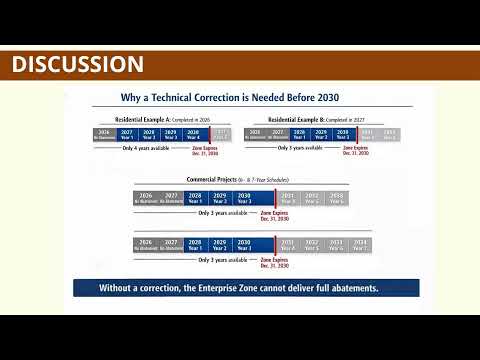
Ortiz walked the board through abatement schedules: a standard five‑year residential or commercial schedule that starts at 100% once the property becomes fully assessed and phases down 20% per year; a six‑year commercial option for projects creating 10 or more full‑time jobs (two years at 100% followed by step‑downs); and a seven‑year schedule for projects creating 50 or more full‑time jobs.
She flagged an administrative issue: current ordinance language states that "the said real estate tax abatement shall terminate upon the expiration of the enterprise zone designation." That wording could cut short multi‑year abatements for projects whose applications are approved before expiration but whose abatement terms would otherwise continue. Ortiz said the Illinois Department of Commerce and Economic Opportunity advised staff to have each taxing district amend its resolution to add a technical correction: "The said real estate tax abatement shall remain in effect for the full term of the approved abatement, provided that the application for such abatement is received and approved prior to the expiration of the enterprise zone's designation."
To pursue that fix, staff asked taxing districts to provide letters of support confirming they would adopt the amended language; Ortiz said the city will provide a template and that there is not an immediate deadline but the letters must be in hand before the city submits the correction to the state. The city is also eligible to apply for a 10‑year extension of the enterprise zone, which would push the designation out to 2040, but Ortiz said the extension requires a separate, lengthy state application and would not eliminate the need for the technical correction as a backstop.
Board members asked procedural questions: staff said they can provide an email template for support letters, there is no immediate firm deadline because boards may need to secure approval from their governing bodies, and boundary changes would require a separate application and are limited by a mileage cap. Ortiz clarified with an example how a partially assessed residential build spanning two tax years would realize its five‑year abatement beginning when the property is fully assessed.
During public input earlier in the meeting, Chris Evans, speaking as a private citizen, urged that enterprise zone incentives should benefit low‑income local residents and hiring for neighborhood jobs rather than primarily serving University of Illinois student housing.
Ortiz said staff will proceed with outreach to taxing districts and the application process; no formal vote was taken. The Enterprise Zone Advisory Board adjourned at 3:39 p.m.