Get Full Government Meeting Transcripts, Videos, & Alerts Forever!
Get email alerts on the AKLNG Tax Policy topic
No spam. Unsubscribe anytime.
Lawmakers hear multi-hour briefing on HB381 — 15¢ AVT, municipal options and community impact funding for AKLNG debated
Summary
House staff, administration and developers briefed the committee on CSHB 381, which would create a 15¢ per 1,000-cubic-foot alternative volumetric tax (AVT), allow municipalities to negotiate mill rates or equity stakes, and include conditional allocations to an Alaska education fund and community impact payments; committee members requested modeling, comparative studies, and revenue-flow visuals.
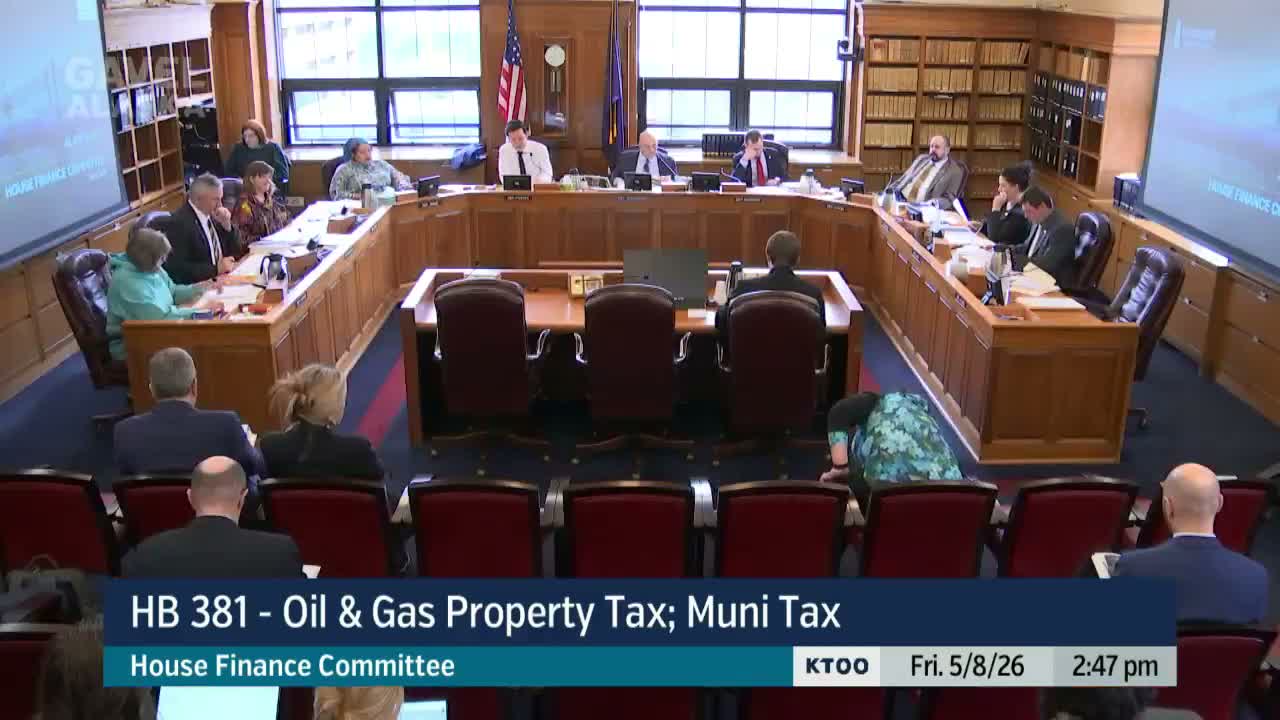
The House Finance Committee received an extended presentation and question-and-answer session on House Bill 381 (CSHB 381) on May 8, a resources committee substitute that lays out tax and revenue treatment for a proposed Alaska LNG (AKLNG) pipeline and facilities.
Calvin Zullo, staff to the House Resources Committee, walked members through version T of the substitute. He said the bill contains legislative intent language to advance the AKLNG project, exempts certain project revenues from local education contribution calculations, allows municipalities hosting parts of the project to apply local property tax or accept an equity stake in lieu of taxes, establishes a 15¢ per 1,000 cubic-foot alternative volumetric tax (AVT) on pipeline throughput (adjusted for inflation after the first year), and includes multiple sunset and conditional-effect provisions tied to certification by the commissioner of revenue and a developer commitment to community impact and labor agreements.
Mark Begich, speaking for the administration, said the bill advances three priorities — deliver energy to South Central, generate state revenue and create jobs — but flagged concerns about two-tier local taxation (mill-levy option vs AVT) and about an equity-for-tax mechanism that could swap forgone municipal mill rates into project equity rather than cash. Begich urged careful drafting and said the administration would provide comparative materials and revenue modeling.
Developer representatives from Glenfarn (Adam Prestige) and commercial partners described the financing challenges for mega-projects and argued that Alaska’s current property-tax framework creates a competitive disadvantage for AKLNG. Prestige and Glenfarn’s commercial partner Matt Kissinger (AGDC commercial director) explained that predictable tax treatment such as a PILT or an AVT is common in other jurisdictions and often necessary to secure project financing. The developer team said the pipeline AVT is designed to be proportionally distributed to pipeline corridor jurisdictions and to all communities via a formula; they also described a proposed $30 million private community impact fund and a 25% advance to affected communities during construction.
Committee members pressed for numeric modeling and comparisons: Representative Bynum asked for a visual that traces where projected revenues (royalties, production taxes, corporate taxes, property/AVT) would flow; Representative Hannon sought clarity on which corporate actors would pay corporate income tax given possible LLC or S-corp structures for some project partners; Representative Josephson raised questions about prioritization if AVT appropriations would slot ahead of other planned 'waterfall' uses of surplus; Representative Galvin sought an explanation of how job estimates and end-user prices would change under different AVT levels. Staff and witnesses committed to provide slide decks, detailed modeling, comparisons to Canadian projects, heat charts on price and cost-overrun sensitivity, and hypothetical state-investment scenarios.
The committee did not vote; members requested additional materials for the next meeting, including a one- or two-page summary of resource-committee changes, revenue-flow visuals, AVT price modeling, and scenario spreadsheets. The committee adjourned and scheduled follow-up for May 11.