Get Full Government Meeting Transcripts, Videos, & Alerts Forever!
Get email alerts on the Bulk Fuel Loans topic
No spam. Unsubscribe anytime.
House Finance reviews fiscal note for bulk-fuel loan-cap bill; staff call impact 'indeterminate'
Summary
Legislative staff told the committee that HB388’s fiscal impact is indeterminate because capitalization depends on surplus waterfalls and a pending amendment that raises per-loan caps. Members pressed staff on capitalization sources, loan timing and average loan size.
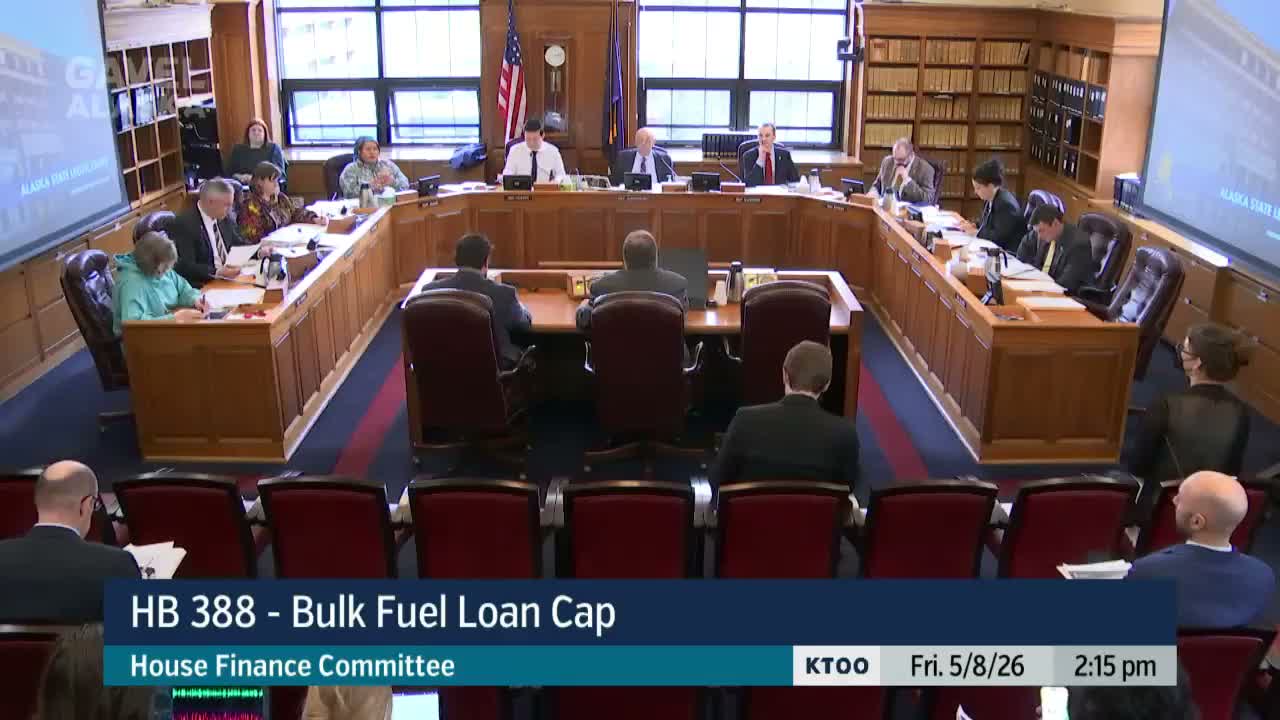
The House Finance Committee reviewed the fiscal note for House Bill 388 — a bill to increase bulk-fuel loan caps — on May 8. Bridal Anderson, staff to Representative Foster, said the House Finance fiscal note treats the measure as affecting fund transfers and the bulk fuel revolving loan fund and described the fiscal impact as indeterminate because it depends on demand and any forthcoming amendment.
"This is an indeterminate fiscal note," Anderson said. "The exact number is unknown at this time, so the amount is indeterminate and it is based on the increased borrowing caps."
Paul LeBull and Paula Bull (staff to Representative Foster) and Lehi Painter (legislative finance) walked the committee through how a 'waterfall' appropriation could work — drawing on any FY26 surplus only to the extent necessary and returning repaid loan funds to the revolving loan fund. Painter said loans are typically repaid by the following May and that money could be recycled into future loans.
Committee members pressed for clarity about capitalization if most applications occur in FY27, whether the amendment would permanently appropriate funds or use a temporary appropriation, and what happens to UGF and the PCE fund if shortfalls occur. Representative Reuben and others emphasized that 'indeterminate' does not mean 'zero' and asked staff to confirm that existing loan balances (about $22 million as of March) and average loan size (roughly $350,000) factor into modeling.
Representative Bynum previewed an amendment concept that would allow the legislature to appropriate a defined amount that reverts as loans are repaid, effectively acting as a temporary capitalization with restoration to the source fund. "Ultimately, no matter what we do, we need to appropriate money," Bynum said, noting a hypothetical $100 million capitalization as an example of a one-time fix but acknowledging the challenge of finding that appropriation.
After extended discussion about amendment language, prioritization in surplus waterfalls, and capitalization mechanics, the committee set HB388 aside pending a written amendment and asked legal counsel be available at the next meeting for drafting questions. No final vote was taken.