Get Full Government Meeting Transcripts, Videos, & Alerts Forever!
Get email alerts on the Opioid Settlement Grants topic
No spam. Unsubscribe anytime.
Porter County council approves opioid-settlement grants to five local recovery and support organizations
Summary
The Porter County Council approved opioid-settlement funding recommendations for five local organizations — the Caring Place, 320 Recovery, Community Change Center, Marine House and the Porter County Health Department — after brief presentations from each group and a procedural exchange about voting protocol.
Porter County Council on Monday approved recommendations from its opioid settlement advisory committee to distribute funds to five local organizations serving people with substance-use and related needs.
Megan Wishwinski, the committee chair, told the council the panel interviewed eight applicants and recommended five organizations for awards. “We talked to each one, what their plans were,” Wishwinski said, noting the committee’s review and recommendation process.
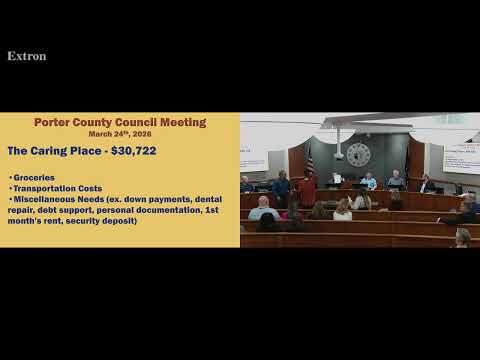
The Caring Place, a Valparaiso domestic-violence shelter with a women’s recovery program, was first to present. Aaron Blumenthal, vice president of operations at the Caring Place, said combining domestic-violence services with substance-use recovery helped both client groups. “When we are able to bring our programs together…we're able to help both our violence clients and our recovery clients,” Blumenthal said. The council approved $30,722 for the Caring Place by voice vote after a motion and second.
Council members then raised a procedural concern: the Caring Place had presented, but several other recommended organizations had not yet given brief remarks to the whole council before the vote. After discussion, the council heard presentations from the remaining four recommended grantees and approved each award separately.
Alexis Steins, marketing development coordinator for 320 Recovery, said the nonprofit would use funds for weekly, peer-led “core pathways” — art, music, fitness, nutrition and faith-based supports — offered at no cost to participants. The council approved $25,000 for 320 Recovery.
Sam Burgett (Community Change Center) described plans to launch community- and jail-based counseling and wellness services now that the center is authorized as a Medicaid and Recovery Works provider; the council approved $23,688 for that program.
Michael O’Connor, executive director of Marine House, a post-treatment recovery home for men, recalled prior grants (a $10,000 award two years ago and $25,000 last year used to remodel client rooms) and requested $18,000 to renovate common areas; the council approved the $18,000 award.
A representative from the Porter County Health Department described plans to install two 24/7-accessible AED “Save Heart” stations (at the Expo Center and Sunset Hill Park), integrate PulsePoint with the county 911 system to alert nearby trained responders, and fund a peer counselor to work with youth in the juvenile detention center. Commissioners committed $20,000 to the project and the opioid settlement committee recommended $27,590; the council approved the committee’s recommendation of $27,590.
The council did not record individual roll-call tallies for most of the grant motions, which were carried by voice vote after motions and seconds. The opioid settlement advisory committee members named during the meeting included Wishwinski, Greg Sims, Barb Brackney, Chuck Harris and Andy Baugh (as recorded).
The council indicated it will follow up on procedural questions raised during the meeting — including requests from some members to have more complete presentations or historical award totals for recurring grantees — and will provide certificates and photo opportunities with grantees following approval.