Get Full Government Meeting Transcripts, Videos, & Alerts Forever!
Get email alerts on the Research Funding topic
No spam. Unsubscribe anytime.
UConn, Yale and research leaders press state for $50 million research fund as federal awards falter
Summary
University witnesses urged the Higher Education Committee to back Senate Bill 428 and related proposals that would create an Academic Research Funding Commission and a $50 million state research fund to shore up universities facing sudden federal grant volatility and to support recruitment of top faculty.
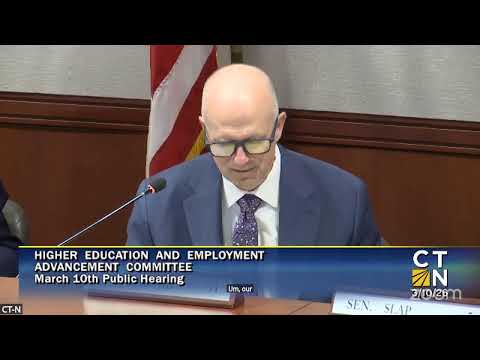
University leaders and researchers told the Connecticut Higher Education and Employment Advancement Committee on March 31 that sudden federal funding disruptions threaten ongoing projects and jobs and urged the state to step in.
Lindseay Dphano, interim vice president for research at the University of Connecticut, testified in support of House Bill 5479 and Senate Bill 428, saying targeted state investment would help Yukon (UConn) compete for membership in a national association of research universities and protect dozens of programs after recent federal non‑renewals. "Membership in a national association of research universities is far more than prestige. It's an economic engine for Connecticut," Dphano said, citing a fiscal‑year 2025 statewide economic impact figure of about $700 million tied to Yukon's research enterprise and the loss of roughly $53 million in federal funding since January 2025.
Dphano described concrete steps in HB5479 to recruit high‑impact faculty, invest in research infrastructure, and strengthen support for current faculty and students. She also urged backing for SB428, which would establish a commission and authorize a $50 million state investment to stabilize universities while federal awards remain uncertain.
Yale's vice provost for research, Mike Quer, told the committee that federal awards have become ‘‘increasingly unstable’’ and that the state has the opportunity to sustain innovation and workforce pipelines if it invests now. He said the number of new federal awards from major agencies has declined sharply and noted that younger investigators and graduate trainees are at particular risk if support lapses.
Committee members pressed witnesses on details: how the state fund would be prioritized, whether the dollars should be targeted at fields the federal government is deprioritizing, and how to ensure oversight and merit review. Dphano and other witnesses emphasized merit‑based, peer review processes and said the state money should complement—not replace—federal funding. Witnesses also highlighted regional partnerships (for example, collaborations between UConn and Yale) as a multiplier of state investment.
No formal vote was taken; committee members signaled interest in working with university leaders on bill language, eligibility criteria and reporting requirements. The committee hearing produced clear support from research institutions for a modest, targeted state fund to bridge federal gaps and protect research capacity and jobs while federal funding is uncertain.