Get Full Government Meeting Transcripts, Videos, & Alerts Forever!
Get email alerts on the Community Solar topic
No spam. Unsubscribe anytime.
Committee hears push for community solar pilot paired with storage, debates costs and consumer protections
Summary
Supporters described HB 5471 as a chance to expand solar access to renters and low‑income households and to pair panels with storage to shave peaks. Utilities warned of high program costs if compensated at near‑retail rates and urged careful tariff design; members pressed for cost containment and siting safeguards.
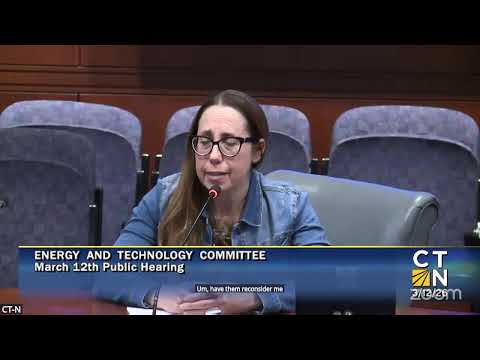
The Energy and Technology Committee spent much of the hearing debating HB 5471, a proposed community solar and energy storage pilot that would let organizations build shared clean energy projects and offer subscriptions to households that cannot host rooftop solar. Proponents said the bill would broaden access to renewable electricity for renters, multifamily residents and low‑income households while pairing panels with storage to reduce peak demand and the need for expensive, dirty peaker generation.
Supporters, including environmental and community advocates, argued the storage requirement is the defining feature: adding batteries to community projects would let operators dispatch firm energy during high‑cost hours and reduce pressure on ISO New England capacity and transmission. "Community solar paired with storage can provide clearer value to the grid and make the benefits reach those who cannot put solar on their roof," said one youth activist who testified in favor.
Utilities and rate‑payer advocates countered that, as written, the bill could be costly if projects are compensated at a high fraction of retail rates and if costs are recovered only from standard‑service customers. An Eversource representative told the committee that an 80% retail‑credit design could add roughly $300 million per year to standard‑service bills — a level that would shift costs toward a shrinking pool of customers and invite retail supply market distortions. DEEP urged that any large new program be paired with clear budget targets and careful PURA rulemaking to avoid rate shock and to protect low‑income households.
Committee members pressed both sides: conservation advocates asked for stronger guarantees that projects actually build new generation and help New England reliability; consumer advocates asked for protections so subsidies do not fall on the most vulnerable; and municipal officials and land‑use advocates urged strict siting rules so projects avoid drinking‑water supply areas and sensitive wetlands.
If the bill advances, the committee is likely to revise the tariff and compensation language, add explicit safeguards limiting cost concentration on standard‑service customers, and strengthen siting and environmental review requirements so that community benefits and grid value are both captured without undue ratepayer risk.
The committee will continue negotiations on how to balance scale, equity and ratepayer protection, and has asked stakeholders to return with cost models and sample PURA tariff language.