Get Full Government Meeting Transcripts, Videos, & Alerts Forever!
Get email alerts on the State Parks Easements topic
No spam. Unsubscribe anytime.
House committee adopts substitute for bill to clarify easements, but members press for limits on new projects
Summary
The House Community and Regional Affairs Committee adopted a committee substitute for HB 220 on May 7, 2026, to clarify easements and rights‑of‑way in state parks. Sponsors and utilities said the measure would allow replacement of aging infrastructure serving dozens of homes; members raised concerns about automatic permit issuance and how the bill could be applied to large new projects.
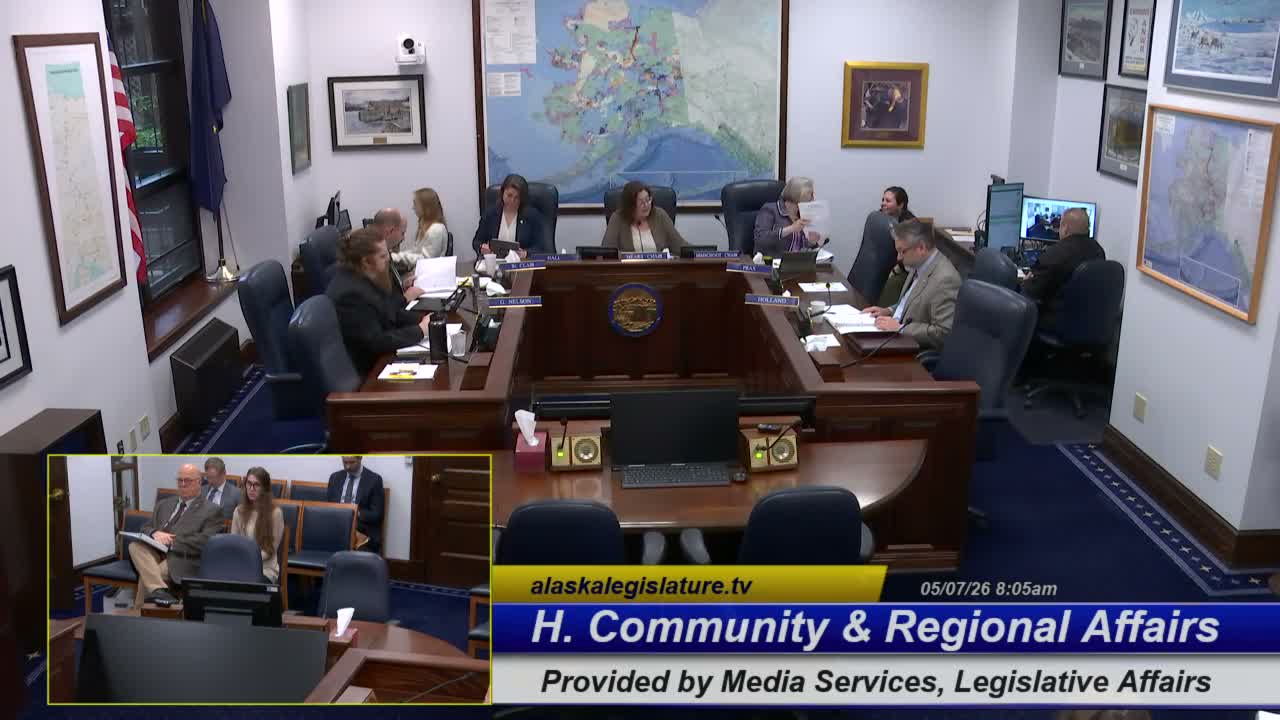
Co‑chair Donna Meares opened the House Community and Regional Affairs Committee on May 7 and said the panel would consider a committee substitute for House Bill 220, which addresses easements and rights of way on state park land. Representative Kevin McCabe (House District 30), the bill sponsor, told the committee the measure is intended to reduce delays and uncertainty for utilities and private inholders that need access across parklands.
"HB 220 tackles these problems head on by establishing clear rules, greater certainty, and stronger accountability," McCabe said, adding the bill directs the Department of Natural Resources to issue an easement "once all statutory requirements are satisfied within a reasonable deadline." He said two parks — Nancy Lake and Kachemak Bay — face aging underwater and other infrastructure that needs replacement and that some 40 to 50 homes around Nancy Lake rely on a 40‑plus‑year old underwater power cable.
Committee staff Elsheba Almeida summarized changes in the committee substitute (version h). She said the CS narrows the bill to state park units only; adds legislative intent and findings that minimally invasive linear utility crossings are generally compatible with park purposes; restructures the statute into a two‑tier system that makes DNR’s granting of easements for existing public utility facilities mandatory while allowing discretionary grants for new facilities; extends the department decision deadline from 60 to 90 days for a completed application; clarifies compatibility with federal Land and Water Conservation Funding restrictions; and defines utility and public‑utility terms to reduce ambiguity.
Members of the committee asked how broadly the new discretionary language could be used. Representative Prox and Representative Kai Holland said the CS’s phrase allowing the department to "may grant" easements for new facilities raised the possibility that large transmission projects could be permitted under the bill’s authority. "That May language kind of leaves a lot of latitude," Holland said, asking what would constrain the size of projects that could proceed.
Matt Wedekind, deputy director for the Division of Parks and Outdoor Recreation at the Department of Natural Resources, said the division currently issues public easements for private inholdings but generally lacks broader permitting authority for utilities; he told the committee he would check departmental staffing and process details and provide answers in writing. Wedekind also noted existing federal restrictions tied to Land and Water Conservation Funding may limit some approvals.
Local stakeholders and utilities testified in support of the CS. Mike Cloweter, president of the Nancy Lake Homeowners Association, said the association represents about 300 homeowners and that more than 40 families rely on the underwater power grid, which is beyond its service life. "HB 220 would allow power line replacement of the existing lines at no cost to the state of Alaska," Cloweter said, urging the committee’s support.
Julie Esty, chief strategy officer for Matanuska Electric Association, said underwater cable installation was a common, cost‑effective practice during earlier build‑out and that many of those facilities have reached the end of their useful life. Esty said methods for replacement depend on engineering, permitting and cost; she and MEA right‑of‑way manager Manny Lopez said GPS and other digital surveying techniques can provide accurate, timely information while cadastral surveys are more comprehensive and costly.
Co‑chair Meares and others expressed reservations about two provisions in the CS: language that would treat an easement as approved if the department does not act within the deadline, and the CS’s specific reference to GPS surveys rather than broader "digital surveying" standards. Meares said she intends to offer amendments to remove the automatic issuance language and to revise the surveying standard, and asked DNR to supply written answers on process and capacity. McCabe acknowledged the concerns and said the CS was intended primarily to enable replacement and maintenance of existing facilities while preserving DNR’s overarching permitting authority.
With objections removed for purposes of discussion, the committee adopted the committee substitute as a working document by voice vote; the transcript does not record a roll‑call tally. Members set an amendment deadline for Monday, May 11 at noon and agreed to continue refining language with staff and DNR.
The committee adjourned at 9:07 a.m.