Get Full Government Meeting Transcripts, Videos, & Alerts Forever!
Get email alerts on the Education topic
No spam. Unsubscribe anytime.
Senate committee hears bill to let regional board members substitute-teach, bar certain felons from boards
Summary
Senate Bill 204 would permit regional school board members to substitute-teach during emergencies and add statutory ineligibility for persons convicted of felonies involving moral turpitude unless unconditionally discharged 10 years prior; sponsor Senator Mike Cronk presented the bill and staff reviewed statutory changes.
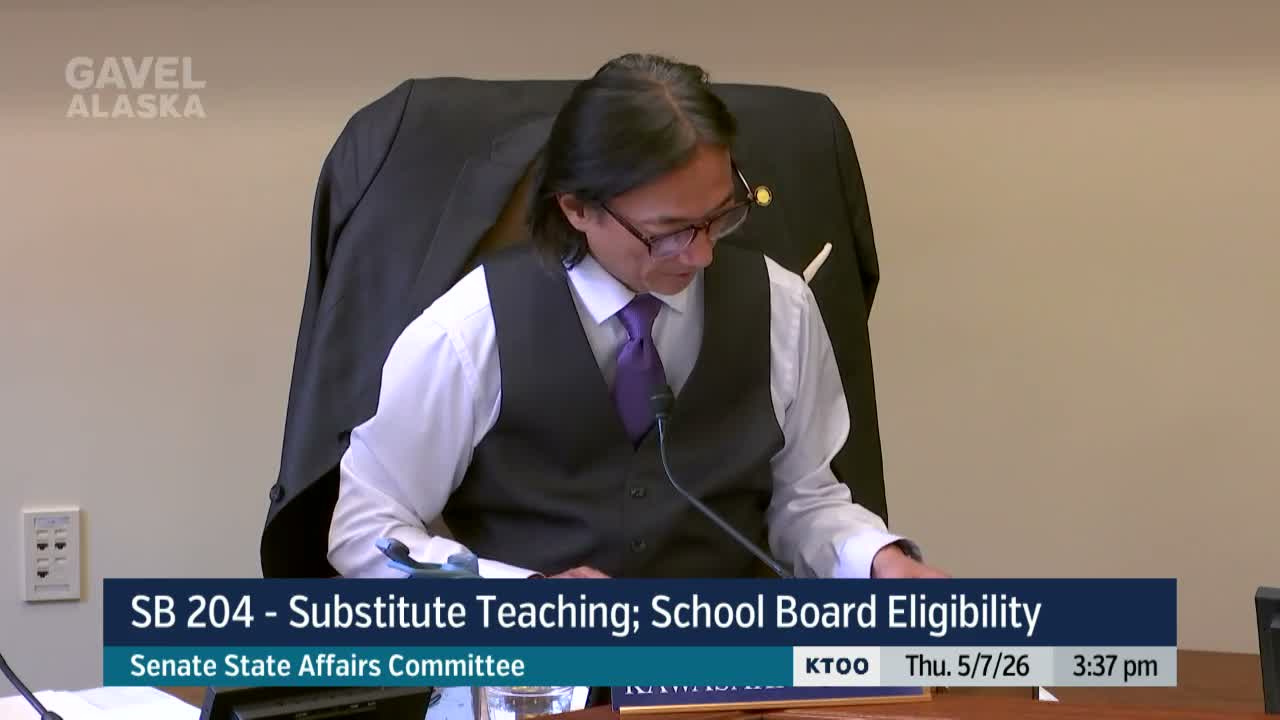
Senator Mike Cronk told the Senate State Affairs Committee on May 7 that Senate Bill 204 would allow members of regional school boards to substitute-teach in their districts under emergency, time-limited circumstances and would add a statutory ineligibility for individuals convicted of felonies involving moral turpitude unless the person was unconditionally discharged at least 10 years before the start of the term.
Cronk said the proposal grew from a resolution passed unanimously by students in the Alaska Association of Student Governments and emphasized parity with existing teacher-hiring standards: "Our students deserve to be surrounded by the best individuals Alaska has to offer," he said.
Paul Menke, staff to Senator Cronk, reviewed the sectional analysis and said Section 1 would amend AS 14.08.041 to allow regional school board members to substitute-teach under emergency circumstances, and Section 2 would amend AS 14.12.080 to add the statutory ineligibility and the 10-year unconditional discharge requirement.
Committee members thanked the sponsor for involving student government and kept public testimony open. The bill was set aside for a future hearing; no committee vote on final passage occurred at the May 7 meeting. Public testimony remains open via the committee email address for additional submissions.