Get Full Government Meeting Transcripts, Videos, & Alerts Forever!
Get email alerts on the Alaska Native Languages Task Force topic
No spam. Unsubscribe anytime.
House committee advances bill to establish joint Alaska Native Languages academic task force
Summary
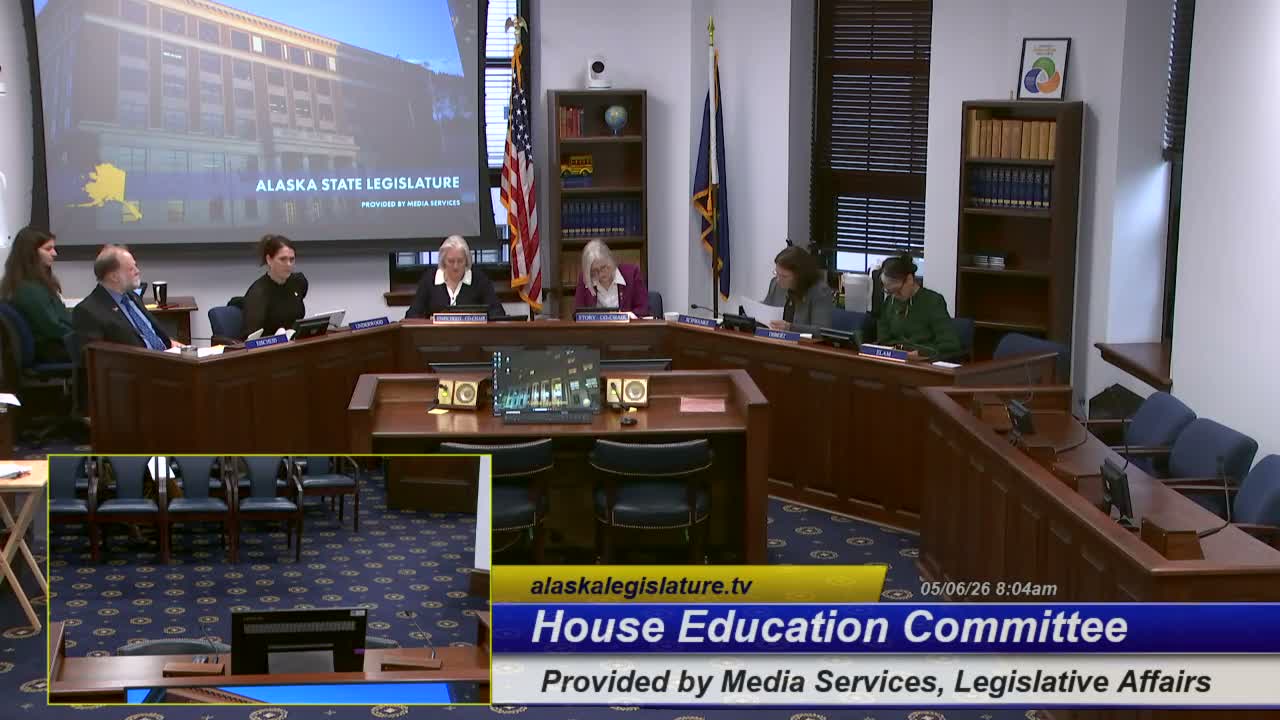
The House Education Committee moved House Bill 387 out of committee as amended on May 6, 2026, after adopting two amendments and rejecting two others that would have added university and DEED seats. Sponsors said the task force will review five decades of Alaska Native language work and recommend strategies for program growth.
Juneau — The Alaska House Education Committee on May 6 moved House Bill 387 out of committee as amended, sending to the next stage a proposal to establish a joint legislative Alaska Native Languages Academic Task Force.
Rep. Story, the bill’s sponsor, told the committee the task force is intended to review 50 years of Alaska Native language work and provide a fresh look at coordination and academic supports. "It's time for a review and some fresh look at what's been happening," Story said during the bill reintroduction.
The committee considered five amendments. Amendment 1, which requires that at least one of the three legislative appointees be a member of the minority, was adopted after supporters said it would broaden voices on the task force. Representative Aisheide, who proposed the change when discussing membership, said the addition would "create a more bipartisan, expansive voice on the task force and strengthen it." Amendment 2, which removed a line of task‑force language concerning staff morale, was also adopted.
Two proposals to add ex officio or appointed seats representing higher education and the Department of Education and Early Development were defeated. Representative Schwanke moved to add a University of Alaska dean to the task force, arguing that including a dean "would be a much more robust process" and allow university staff to weigh in. Opponents countered that the vehicle is a legislative task force and that stakeholder input from universities can be solicited without making staff voting members. That amendment failed on a roll call, 2 yeas to 4 nays. A separate amendment to add a DEED appointee likewise failed by the same margin.
After the amendment votes, Rep. Story moved the bill "as amended with attached fiscal notes and individual recommendations" and authorized legislative legal to make conforming changes; with no objection, HB 387 moved from committee.
Committee discussion focused on membership balance and the task force’s scope rather than the substance of mission statements in the draft language. The record shows the committee did not adopt proposals to place university or DEED staff as voting task‑force members, and instead preserved a largely legislative composition with direction to solicit stakeholder input.
Next steps: HB 387 moves forward from committee with the adopted membership language and attached fiscal notes; the bill may be scheduled for further floor or cross‑chamber consideration according to legislative scheduling.