Get Full Government Meeting Transcripts, Videos, & Alerts Forever!
Get email alerts on the Municipal Budget topic
No spam. Unsubscribe anytime.
Encinitas projects a structurally balanced FY27 budget and roughly $8.65M to allocate; council readies priorities
Summary
City staff presented a five‑year financial outlook showing revenues of about $126 million and baseline expenditures of $124.6 million for FY27, producing a modest budgetary surplus and roughly $8.65 million in unassigned funds available for capital and operating requests; council and residents urged prioritizing rail safety, facility maintenance and other projects.
Encinitas city staff told the council at a special budget workshop that the city’s baseline finances are structurally balanced and that crews and departments are preparing candidate projects for the FY26–27 budget.
Assistant Finance Director Nikki Schoffont presented a five‑year outlook showing projected revenues of roughly $126 million in FY27 and baseline expenditures of about $124.6 million. Schoffont said the projection shows “a structurally balanced budget where our ongoing revenues are expected to exceed ongoing expenses,” and staff noted examples of planned uses for the projected surplus such as infrastructure and asset replacement.
The presentation explained that property tax is the largest single source of general fund revenue (about 60% in the FY27 projection) and that, under state law, only a portion of each property tax dollar — roughly 24 cents of each dollar collected — remains for the city after schools, counties and special districts receive their shares. Staff also presented a long‑range debt service chart showing roughly $5.5 million in annual governmental debt service obligations today, with the general fund covering about $5.0 million of that total and parkland mitigation fee revenues covering roughly $500,000.
City finance staff summarized midyear results and unassigned balances: after audit adjustments and midyear items, the city’s current unassigned fund balance stood at about $7.7 million; combined with the projected FY27 appropriation surplus of roughly $950,000, staff said about $8.65 million would be available to allocate in the upcoming budget process. The city manager cautioned that an anticipated $2.66 million FEMA reimbursement has not yet cleared all administrative steps and therefore should not be counted as available until confirmed. “I don’t want to count the chickens before they’re hatched,” the city manager said.
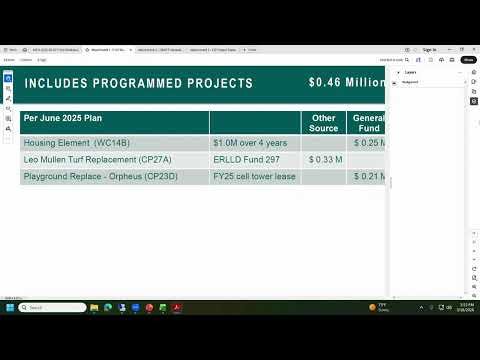
Council members and staff discussed how to use the available funds and how to sequence projects over a five‑year CIP. Several uses were highlighted in staff materials: design and construction of Lucadia at‑grade rail crossings, quiet zone work, the housing element (programmed at $250,000 over four years), turf or playground replacements funded from special funds, $1.7–$1.9 million estimates for a temporary Fire Station 6 buildout, and several right‑of‑way and paving projects funded by gas tax and TransNet allocations. The draft budget calculator that staff displayed shows a preliminary net shortfall of roughly $715,000 under the current draft allocations; staff said the council’s April 8 workshop would be used to reach a zero‑balance draft and prioritize items.
What happens next: staff will provide detailed maintenance and lifecycle cost follow‑ups for selected items (for example, the proposed Cornish parking rehabilitation), refine project phasing and cost estimates for corridor projects, and return on April 8 with the council’s individualized budget calculators to finalize allocations for the budget introduction.
No formal vote occurred at the workshop; the council directed staff to return with follow‑up information and proceed to the next workshop step on April 8.