Get Full Government Meeting Transcripts, Videos, & Alerts Forever!
Get email alerts on the Zoning Text Amendment topic
No spam. Unsubscribe anytime.
Natrona County P&Z tables warehousing zoning amendment, asks staff to study setbacks and lot size
Summary
The Natrona County Planning and Zoning Commission on March 10, 2026 voted unanimously to table a proposed zoning-text amendment (TA26-01) that would create a separate 'warehousing' use; commissioners asked staff to return in April with options on setbacks, minimum lot size and building-size controls.
The Natrona County Planning and Zoning Commission on March 10, 2026 voted to table TA26-01, a zoning-text amendment that would define and separately regulate 'warehousing' as the storage of personal property in enclosed structures, and asked staff to return with options on setbacks, minimum lot size and maximum building-size limits ahead of an April 14, 2026 recommendation to the county commissioners.
Planning staff summarized the text amendment and said the draft would remove “mini storage” from the warehousing definition, create a new section specifically for warehousing, and set a proposed minimum lot size at two acres for the use. The staff presenter said the two-acre figure came as a compromise after initial discussion of five acres and conversations with commissioners, code enforcement and residents; staff also noted the county’s health department has indicated two acres is a common minimum for future septic feasibility, though septic needs were not the amendment’s primary driver.
"This is a text amendment requested by the planning department to remove the term warehousing from the wholesale distribution, warehousing, and storage section and to define warehousing as the storage of personal property within an enclosed structure for use by the property owner," the staff presenter said. The staff presenter also noted that the amendment would create a table of allowable zones for warehousing and that several zones (manufactured-home parks, some recreational districts) were intentionally excluded.
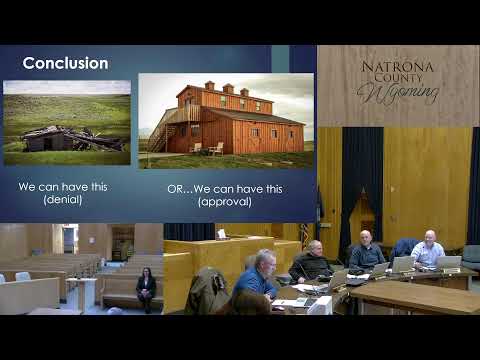
Commissioners pressed staff on several potential unintended consequences. One commissioner said even a two-acre minimum could allow very large structures because some zones permit up to 50% lot coverage, and cautioned a large non-residential building on a neighboring parcel could block views or change neighborhood character. "If we go the way it's currently written, I think it could lead to problems," a commissioner said, urging further thought on lot coverage, height and appearance standards.
Staff acknowledged the concern and described the zone-certificate (ZC) review as an extra step for certain cases: "There's a completeness review and different things we have to go through to make sure it complies," the staff presenter said, noting the ZC process checks setbacks and other site-plan details. The presenter also said many zones have no specific non-residential height limit, so height could vary by zone unless the commission specifies otherwise.
Commissioners also asked whether the definition would exclude livestock; staff replied the "includes but not limited to" language was intended to allow barns and livestock structures and that the amendment could explicitly add livestock if the commission wanted clarity.
With no public in attendance, the commission opened and closed the public hearing with no comments. After further discussion about options—raising the minimum lot size to five acres, doubling side and rear setbacks, imposing a percentage-based maximum building size, or keeping the two-acre threshold with added safeguards—a motion to table the amendment to the April 14 meeting passed unanimously. The motion directed staff to prepare options addressing setbacks, minimum lot size and building-size/lot-coverage standards for each affected zone.
The commission did not record a roll-call vote naming individual votes in the transcript; the chair announced the motion passed unanimously and that the commission would forward its recommendation and any proposed amendments to the county commissioners in April.
The meeting also included the approval of minutes from the Feb. 10, 2026 meeting and a brief introduction of new planning technician Maddie Pennington. The meeting adjourned at about 6:40 p.m.