Get Full Government Meeting Transcripts, Videos, & Alerts Forever!
Get email alerts on the K‑12 Assessment topic
No spam. Unsubscribe anytime.
Hillsborough presents 2025 NJSLA and DLM results; district outperforms state in most grades
Summary
Assistant Superintendent Dr. Lisa Rabimus presented spring 2025 NJSLA and DLM results showing the district outperformed New Jersey averages across ELA, math and science; administrators flagged cohort growth and called for targeted interventions for groups lagging behind.
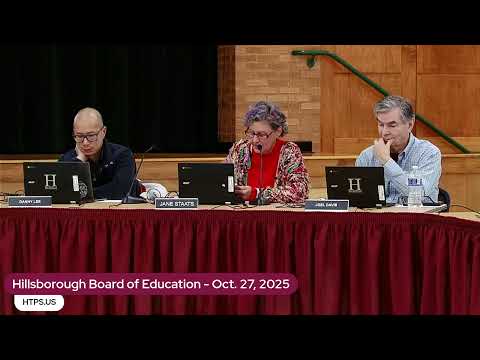
Dr. Lisa Rabimus, the district’s assistant superintendent, presented the Hillsborough Township Public School District’s spring 2025 New Jersey Student Learning Assessment (NJSLA) and Dynamic Learning Map (DLM) results to the board on Oct. 27.
The presentation showed district participation of 3,913 students on the NJSLA and higher percentages meeting or exceeding expectations than the state average across tested grades. Dr. Rabimus highlighted strengths in mathematics—grade 4 proficiency was 78.8% districtwide while algebra 2 test-takers in the district recorded 100% proficiency—and said several grades and cohorts showed measurable year-to-year growth. For English language arts, the district “continues to far exceed the state percentage” with grades 4 and 7 noted among the highest-performing cohorts. The DLM assessment, for students with the most significant cognitive disabilities, included 67 students in ELA and 69 in math with a range of performance levels reported.
Why it matters: board members and administrators said the results will drive curriculum and intervention planning. Dr. Rabimus described how the district uses multiple data sources—including cohort tracking, I‑Ready and LinkIt benchmark data—to identify students for targeted Tier 2 and Tier 3 supports under the New Jersey Multi‑Tiered System of Supports.
Board members asked for subgroup and cohort clarifications during the Q&A. One member noted that the Asian student subgroup consistently outperformed other groups and asked the administration to examine structural or sociological factors; Dr. Rabimus and data staff said subgroup analysis, English‑proficiency levels for multilingual learners, and multi‑year cohort growth are already part of the district’s analytic work. Casey Dullah, a district supervisor, attributed gains in advanced algebra outcomes in part to improved middle‑school instruction and better alignment of assessments to classroom practice.
Administrators cautioned that cross‑year comparisons involve different student cohorts and recommended interpreting shifts alongside enrollment and subgroup changes. Dr. Rabimus identified a few gaps to monitor—particularly in some ELA subgroup measures—and encouraged continued use of disaggregated data to inform curriculum adjustments and interventions.
What’s next: the district’s data teams will continue analyzing results to identify individual student needs and programmatic priorities; the administration also plans to bring a staff committee recommendation on field‑trip and out‑of‑school learning processes back to the education committee for review.
Quotes: “The district continues to outperform the state in all areas with exceptional mathematics results,” Dr. Rabimus said. On algebra 2 gains, data staff said they have adjusted middle‑school assessments and instruction to prepare students for word‑problem and literacy‑based work on state tests.
Ending: The presentation closed with recognition of the supervisors who supported the analysis. Board members thanked staff and moved the meeting on to the district audit presentation.