Get Full Government Meeting Transcripts, Videos, & Alerts Forever!
Get email alerts on the House Bill 1113 topic
No spam. Unsubscribe anytime.
House committee reviews bill to create 'green home' special permit amid infrastructure and affordability concerns
Summary
Lawmakers and witnesses debated House Bill 1113, which would create a special permit for off-grid 'green homes' on rural-common land. Presenters praised the concept but the Planning Board opposed removing planning review; members warned about water, road and electricity constraints and unclear affordability protections.
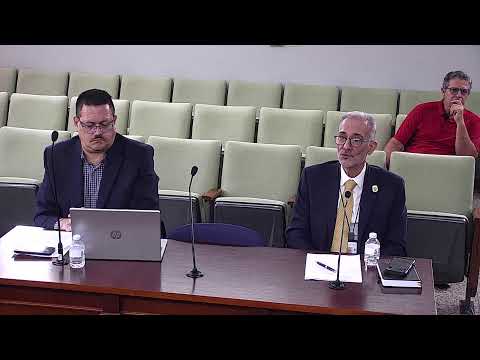
The House Committee on Economic Development heard testimony on March 19 about House Bill 1113, a measure to establish a special construction permit for "hogares verdes" (green homes) intended to facilitate single-family housing on land classified as "suelo rústico común." The bill was introduced by the president of the House and was presented to the committee by the Office of Permits.
OGP attorney Viviana Pereira summarized the measure and read its qualifying criteria, saying the bill would allow up to seven lots counted from the original finca, require individual lots of at least 700 m², limit homes to two stories, and require dwellings to be operable without dependence on state utilities by relying on wells or private aqueducts for water, solar or gas for electricity, septic systems with solar aerators, and wireless or satellite telecommunications. Pereira also said structures must comply with the Puerto Rico Building Code and obtain environmental determinations, and she noted the joint regulation already includes a "permiso verde" that might overlap with the bill’s provisions.
"La oficina de Gerencia de Permisos reconoce la importancia de promover alternativas que faciliten el acceso a vivienda," Pereira said, while also deferring detailed compatibility review to the Puerto Rico Planning Board.
Representative Adriana Gutiérrez Colón said the proposal "suena bonito," but asked whether liberalizing development on rural-common land is the right policy for affordable housing. "¿Por qué ustedes entienden que estas clasificaciones como de suelo rústico son restricciones irrazonables?" she asked. Pereira replied that while the OGP recognizes restrictive rules can hinder supply, affordability is driven by multiple factors, including market costs and inflation, and that the agency does not set sale prices.
Several lawmakers pressed OGP on practical barriers. Committee members described frequent delays when a permit depends on recommendations or endorsements from other agencies — for example, Acueductos or the electric utility — and said some regions experience multi-year waits for approvals. "Puede tomar años en mi región para que acueducto apruebe un proyecto," one member said. Pereira answered that ministerial approvals can be fast when dossiers are complete, but discretionary procedures such as consulta de ubicación will continue to take longer when agency endorsements are required.
Members debated technical permit conditions the bill imposes. Some questioned the requirement that each lot have access via a paved public road, warning that requiring pavement could block small family projects in municipalities that lack funding to pave short stretches. Others raised environmental concerns about allowing private wells and septic systems: one legislator said private systems can contaminate aquifers if not properly regulated; Pereira replied that engineering certification and existing agency reviews would still apply.
Lawmakers also queried whether the bill truly addresses affordability. The committee discussed a price-related figure that appears in written materials (a $175,000 threshold appears in the text cited during discussion), but Pereira said sale prices are determined by the market and the agency does not fix final costs; the role of the dollar figure in the bill was not clarified during the hearing.
The Association of Builders, represented by legal advisor José Alberto Feliciano, said the measure "abre una discusión importante" but would only address a limited segment of the housing need because of unit and lot-size limits. Feliciano urged broader permitting and planning reform to scale solutions.
Héctor Morales Martínez, president of the Puerto Rico Planning Board, told the committee the Junta does not agree with the bill as drafted. Morales argued that "suelo rústico común" is already the most flexible land class, that consultation and planning review serve to evaluate infrastructure impacts, and that exempting projects from consultation could duplicate or undermine planning instruments. He and other speakers discussed reinstating or adapting the historical "notificación simple" track for small lot divisions and emphasized that infrastructure capacity — water, wastewater, roads and electricity — is the principal constraint on expanding buildable supply.
Committee members spent much of the hearing probing tradeoffs: whether to prioritize rehabilitation of vacant urban housing and incentives for urban redevelopment or to expand rural opportunities through a permissive green-home permit. Several members urged that any measure be tied to infrastructure investments or clearer safeguards to prevent environmental harm or service gaps.
No formal vote or final action was taken during the session. The committee heard the written presentations, received questions and comments from members, and closed the hearing with no immediate approval recorded.