Get Full Government Meeting Transcripts, Videos, & Alerts Forever!
Get email alerts on the Miranda Waiver topic
No spam. Unsubscribe anytime.
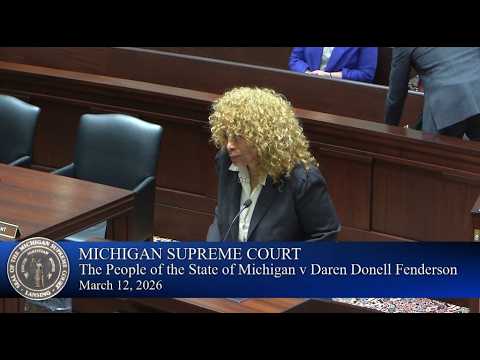
Michigan Supreme Court hears arguments over whether police statements negated Miranda waiver
Summary
In a mini-oral argument, defense attorneys and amicus advocates told the Michigan Supreme Court that officers' statements such as "you don't get one" and "you ain't got no money" coerced a later waiver by Darren Fenderson; prosecutors countered that the waiver was voluntary under the totality of the circumstances and existing precedent.
LANSING — The Michigan Supreme Court heard mini-oral argument in People v. Darren Fenderson over whether police statements and conduct during an interrogation nullified a subsequent waiver of Miranda rights.
Coral W., defense counsel for Darren Fenderson, told the court that officers misled her client by saying phrases captured on video — "you don't get one," "you don't got one," and "you ain't got no money" — and then pressing for a waiver while Mr. Fenderson repeatedly expressed confusion. "Those words and the conduct of the police would have led anyone to believe that they didn't have a right to counsel," Coral W. said, arguing the police did not "scrupulously honor" the defendant's invocation and that any waiver that follows such misleading statements is not "knowing, intelligent, and voluntary."
Sophia Nelson, appearing for the Criminal Defense Attorneys of Michigan, urged the court to read Michigan's Article I, Section 17 (the state constitution's "fair and just treatment" clause) as an independent basis to provide stronger protection than the federal Fifth Amendment. Nelson argued the court could adopt a per se rule suppressing waivers obtained after police have misled a suspect about counsel and cited Goldston factors and social-science amicus briefs in support of a more protective state constitutional rule.
Justices pressed Nelson about federal precedent, including Tanner, and whether that case limits the court's options. Nelson responded that Tanner is cabined to self-incrimination doctrine and did not apply the Goldston factors; she said officers could have remedied misleading statements by ceasing the interrogation, removing the suspect from the room, or explicitly stating that an attorney would be provided.
Lori Bauman, Palmer, representing Wayne County on behalf of the people of the state of Michigan, countered that the central question is whether the defendant understood his Miranda rights and voluntarily waived them. Bauman argued that voluntary confessions play an "essential" role in law enforcement and that, under the totality of circumstances and existing precedent (including Edwards and Tanner), the Court of Appeals did not err in finding the waiver valid. She disputed characterizations of the officers' conduct as an intentional "scare tactic," saying the record did not reliably show a purposeful delay to break the defendant.
During extended questioning, justices explored whether the interrogation was "prolonged," whether police efforts to locate counsel were adequate, and what standard of review the court should apply to video-based factual disputes. Prosecution counsel said there was no reliable evidence of an intentional refusal to find an attorney and emphasized that courts must assess voluntariness by viewing the interrogation "as a whole." Defense counsel replied in rebuttal that video shows Mr. Fenderson "break[] and he's crying," repeatedly saying he did not understand, and that officers' statements and the circumstances rendered the waiver involuntary.
The case was submitted to the court at the conclusion of oral argument. No date was given in the argument for a decision.