Get Full Government Meeting Transcripts, Videos, & Alerts Forever!
Get email alerts on the School Finance topic
No spam. Unsubscribe anytime.
Oakrove School District to tap reserves and present fiscal stabilization plan after county flags multi-year deficit
Summary
Associate Superintendent Mark Evans told the district community that Oakrove faces a structural multi-year deficit, will use limited reserves and Fund 40 transfers this year, and must deliver a board-approved fiscal stabilization plan to the Santa Clara County Office of Education before the December first interim report.
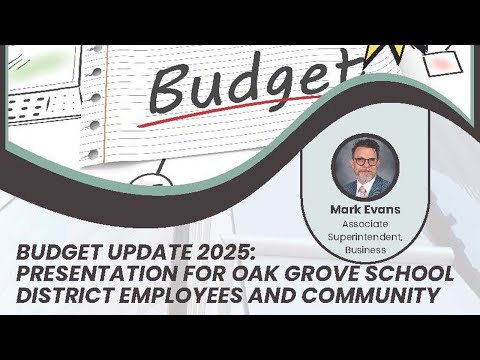
Associate Superintendent of Business Mark Evans said the Oakrove School District is facing a persistent multi-year budget gap and will present a board-approved fiscal stabilization plan this fall after the Santa Clara County Office of Education issued a conditional approval of the district’s finances.
Evans told meeting participants that when the board adopted the district’s 2025–26 budget in June it estimated revenues of about $141 million and expenditures of roughly $152 million, leaving an approximately $11 million gap. He said recent state actions — including a one-time $1.7 billion distribution to districts nationwide and a higher-than-expected TK add-on — reduced the projected 2025–26 shortfall to about $8 million, but those improvements are not ongoing revenue sources.
“The state provided about $2.5 million to us as one-time funds in 25–26, and the TK add-on increase will give us roughly $400,000 more annually,” Evans said. “Those one-time dollars help this year, but they do not solve the multi-year deficit.”
Evans explained that Oakrove’s primary operating revenue comes from the Local Control Funding Formula (LCFF), a mix of local property tax revenue and state aid, and that federal funds are declining to an expected roughly $4.1 million next year. He said total estimated general fund revenue rose to about $144.4 million after including the one-time payment and TK funding, while projected expenditures remain near $152 million.
Because the district lacks adequate ongoing revenues to close the gap, Evans said leaders plan to rely in part on capital reserves (Fund 40) to keep the general fund solvent in the near term. He reported that the district’s ending fund balance across funds was roughly $35 million: about $24 million restricted by state or federal rules and about $10 million unrestricted. Of the unrestricted portion, the district must hold a required reserve (about $4.5 million), leaving roughly $5.3 million of one-time unassigned funds in the general fund.
Fund 40, the capital outlay reserve, holds roughly $32 million, Evans said, of which about $11.8 million is restricted by state allocation rules and about $20 million is more flexible. He said an estimated $16 million of Fund 40 would be needed to cover projected deficits across the three-year outlook, leaving about $3.6 million remaining if that transfer proceeds.
“The problem the county highlighted is continued dependence on transfers from other funds,” Evans said, summarizing the Santa Clara County Office of Education’s view. He read from the county’s letter that without the projected Fund 40 transfers the district would have a negative general fund balance in all three years of the projection, and that reliance on one-time transfers is not sustainable.
To comply with the county’s conditional approval, Evans said the district must submit a board-approved fiscal stabilization plan with supporting documentation as part of its first interim submission in December. He said the district has convened a budget advisory committee of parents, bargaining-unit members and staff and will present its recommendations to the board in November.
Evans outlined the district’s near-term targets: approximately $3 million of expenditure reductions for the 2026–27 year and an additional $2 million the following year. He noted that 78% of general fund spending is salaries and benefits (about $119 million of the $152 million budget), meaning significant reductions will be difficult to achieve without affecting personnel.
Some savings are already in place, Evans said, including retirements and unfilled positions that yielded about $1 million in savings; the district has avoided filling some roles, restructured others and will shift some costs to bond funds where allowable. He also said the district will pursue modest revenue opportunities such as increasing property leases and improving student attendance but cannot count on voter-approved tax measures in the near term.
During the public Q&A, Evans answered a question about property tax funding, explaining that Oakrove is not a “basic aid” district and therefore relies on state aid to fill the LCFF bucket after local property taxes are applied. Facilities and teacher compensation were raised as follow-ups; Evans invited detailed facility questions by email and said teacher contract demands will be part of the stabilization discussion.
The budget advisory committee will finalize recommendations for the board in November; the board’s adoption and the district’s first interim report to the county are due in December.