Get Full Government Meeting Transcripts, Videos, & Alerts Forever!
Get email alerts on the Cultural Resources topic
No spam. Unsubscribe anytime.
Plan Commission reviews cultural-resources chapter updates to strengthen tribal coordination and preservation
Summary
County planners presented draft revisions to the comprehensive plan's cultural resources chapter that add tribal consultation rules, acknowledge tribal aboriginal territory, recommend inadvertent-discovery protocols and propose stronger funding language for the local historic preservation office.
Josh Warwick, lead staff on the cultural resources update, told the Spokane County Plan Commission on March 26 that the draft chapter was revised to align with Growth Management Act (GMA) requirements and Washington Administrative Code guidance and to strengthen tribal partnership and preservation policies. He said staff worked with the Spokane Tribe, the Kalispel Tribe, the Coeur d'Alene Tribe and the Colville Tribe and incorporated a policy audit from the Spokane Tribe into the draft.
"We really wanted to demonstrate that the tribes are our partners in this process and that we are utilizing them for the identification of tribal resources," Warwick said, and described adding ethnographic documentation, consultation protocols and acknowledgement of aboriginal territory maps in the plan's introduction. The draft also adds explicit guidance on inadvertent discovery and archaeological procedures and recommends consulting tribes before nominating traditional cultural properties to public registers.
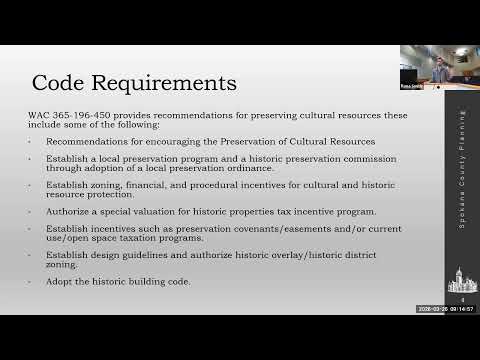
Warwick said staff proposed changing several policy statements to strengthen implementation language (for example, where the plan previously used "should" staff suggested stronger direction) and recommended funding the joint city-county historic preservation office more reliably. He listed incentives that could support preservation work, including tax relief, conservation easements, technical assistance and recognition programs, and proposed new coordination tools such as interlocal agreements to help smaller jurisdictions preserve historic resources.
Why it matters: The changes would formalize tribal consultation early in identification and nomination processes, aim to protect archaeological and sacred sites when ground-disturbing development occurs, and seek to provide resources to support preservation work across the county. Warwick said the draft policies are not final and staff will incorporate further tribal and public comments before returning revised language for commission review.
What's next: Staff asked the commission for feedback and said they will continue outreach with tribes and other stakeholders; public and commission comments will be folded into subsequent drafts ahead of the DEIS and final plan steps.